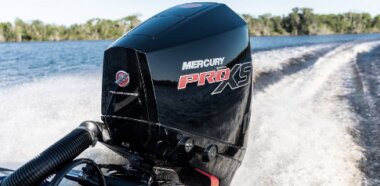
Yamaha F70A Specifications
| Engine Model: Yamaha F70A |
| Engine Type: 4-stroke inline 4-cylinder SOHC 16-valve gasoline outboard engine |
| Total Displacement: 60.8 cu.in (996 cc) |
| Rated Engine Power: 70 Hp (51.5 kW) at 5800 rpm |
| Fuel System: Electronic Fuel Injection (EFI) |
____________________________________________________________________________________
The Yamaha F70A is a 70-horsepower,
four-stroke, in-line four-cylinder outboard engine, representing a
landmark achievement in outboard engineering as the lightest 70hp
four-stroke in its class. This model is configured for remote control
operation and is equipped with electric starting and a hydraulic power
trim and tilt system, offering boaters a sophisticated, powerful, and
exceptionally smooth experience.
Built on an advanced 996cc platform, the F70A is renowned for its
groundbreaking power-to-weight ratio, quiet operation, outstanding fuel
efficiency, and the seamless response of its Electronic Fuel Injection
system, making it a versatile and dependable choice for a wide array of
boats including RIBs, aluminum fishing boats, and pontoons.
The Yamaha F70A is constructed around a refined and efficient powerhead.
It features a 4-stroke, SOHC, in-line 4-cylinder, 16-valve engine
configuration. The engine displacement is precisely 996 cc (60.8 cu in),
achieved through a bore and stroke of 65.0 mm x 75.0 mm (2.56 in x 2.95
in).
This powerhead produces a maximum prop shaft output of 51.5 kW (70 hp)
at 5,800 rpm. The engine is engineered to operate within a full throttle
operating range of 5,300 to 6,300 rpm, with a specified engine idle
speed of 700-800 rpm. The compression ratio is stated as 9.4:1.
The power unit of the F70A is engineered for durability, efficiency, and
smooth power delivery. The long-stroke design contributes to high power
output and remarkably smooth operation with low noise and vibration
levels. The advanced powerhead features a single overhead camshaft
(SOHC) with four valves per cylinder, maximizing power and efficiency.
Total intake valve area is increased, while the pistons and valves are
lighter, giving it substantially more horsepower-per-litre of engine
displacement than competitive outboards. The overhead camshaft design
efficiently exchanges intake and exhaust gases for responsive power and
fuel efficiency.
Air entering the engine is routed through a single throttle valve to
ensure precise air metering, then enters each cylinder through
individual long, pulse-tuned intake tracks for maximum density and
power. The valve train requires periodic adjustment, with specified
valve clearances of 0.15-0.25 mm (0.006-0.010 in) for the intake valves
and 0.25-0.35 mm (0.010-0.014 in) for the exhaust valves when the engine
is cold.
The F70A features Yamaha's advanced Electronic Fuel Injection (EFI)
system, which precisely meters fuel for optimal combustion under all
conditions. Four individual compact electronic fuel injectors deliver
the exact amount of fuel needed for optimum performance and economy,
with their location just above the intake valves enhancing fuel
atomization for more efficient combustion. Managed by an Engine Control
Module (ECM) microcomputer via input from an array of on-engine sensors,
this system ensures cleaner performance, impressive fuel economy, and
seamless throttle response.
The F70 derives every bit of power available from the fuel by using
Vapour Reduction and Vapour Burning Systems, which eliminate vapour from
the fuel rail and prevent fuel vapours from escaping to the atmosphere.
The recommended fuel is regular unleaded gasoline with a minimum octane
rating of 87. The engine is supplied with fuel from a separate tank with
a capacity of 25.0 L (6.6 US gal).
The lubrication system is a wet sump type, meaning the engine oil is
stored in a sump within the engine. The recommended engine oil is
high-quality 4-stroke outboard motor oil, such as Yamalube 4-M FC-W
10W-30, meeting API SE, SF, SG, SH, SJ, or SL service classifications.
The engine oil capacity with oil filter replacement is 2.1 L (2.2 US
qt).
The cooling system is raw-water with thermostatic control, drawing water
from the body of water to cool the engine. A freshwater flushing device
is integrated for easy maintenance. The F70 features an outer cowling
design with an intake air drain system to efficiently drain away any
water that enters the cowling during normal engine operation.
Exhaust gases are expelled through the propeller boss for efficient
underwater exhaust and noise reduction, with engine exhaust routed
through a maze before exiting above the waterline through the idle
exhaust relief outlet for unbelievably smooth and quiet operation. A
large anti-splash plate on the front of the lower mid-section helps keep
water from splashing up between the outboard and the boat for a dryer
ride.
The ignition system is a TCI (Transistor Controlled Ignition)
microcomputer unit, providing precise spark timing for reliable starting
and efficient power across the RPM range. The specified spark plugs are
NGK LKR7E, with a required gap of 0.8-0.9 mm (0.031-0.035 in).
The charging system incorporates a high-output alternator of 12V - 15A
or 17A with a built-in rectifier/regulator to maintain battery charge
for the electric start and other electrical accessories.
| Mid Section and Lower Unit |
The lower unit is engineered for strength and efficiency. It uses a
spiral bevel gear with a reduction gear ratio of 2.33:1 (28/12) , which
provides outstanding hole shot and acceleration. Specially hardened
pinion, forward, and reverse gears increase durability.
The gear shift positions are the standard Forward-Neutral-Reverse
(F-N-R), engaged via a positive-action dog clutch. The propeller shaft
utilizes a spline drive system, and the propeller direction, when viewed
from the rear, is clockwise. The correct lubricant for the lower unit is
hypoid gear oil meeting API GL-4 SAE 90 specifications, with a gear oil
capacity of 0.67 L (0.70 US qt).
This outboard is equipped with a hydraulic power trim and tilt system,
allowing for effortless adjustment of the engine angle with the touch of
a button. The trim angle can be adjusted through a wide range, from -4
degrees to +16 degrees , enabling the operator to fine-tune the boat's
attitude for optimal performance, fuel efficiency, and ride quality
under various load and water conditions. Negative trim angles improve
acceleration and help achieve planing quickly.
For shallow water operation, the system provides a standard shallow
water drive feature, allowing the engine to be operated at a tilted
angle for safe navigation. The maximum tilt-up angle is 65 degrees. The
steering angle is 40 degrees to both port and starboard. The F70
utilizes a Long Span Mounting System, which uses large specially
constructed rubber engine mounts placed as far apart vertically and
horizontally as possible for smooth and quiet operation.
The Yamaha F70A is compatible with a range of aluminum propellers to
match various boat types and applications. Authorized Yamaha dealers can
recommend the correct propeller based on boat hull, load, and intended
use to ensure the engine operates within its recommended full-throttle
RPM range of 5,300-6,300 rpm.
The Yamaha F70A is available in a long shaft configuration. The overall
length is 698 mm (27.5 in) and the overall width is 386 mm (15.2 in).
The overall height is 1,476 mm (58.1 in) with a transom height of 534 mm
(21.0 in). The dry weight for this model is 115 kg (253 lb).
Regular maintenance is essential for the longevity of the F70A. The
engine oil and oil filter should be changed according to the
manufacturer's schedule. The gear oil in the lower unit should be
checked regularly for the presence of water or metal particles and
changed annually or every 100 hours. The water pump impeller is a wear
item that should be inspected and replaced periodically, every 1-2 years
or if there are signs of reduced cooling water flow, to prevent
overheating.
The spark plugs should be removed, inspected, cleaned, and the gap
adjusted annually, and replaced as needed. Valve clearance inspection
and adjustment should be performed at recommended intervals. All moving
parts, such as steering linkages and tilt tube, require regular greasing
with water-resistant marine grease to prevent corrosion and ensure
smooth operation. A large, on-engine water-separating fuel filter with a
water sensor helps separate water and contaminants from the fuel before
they can reach the injectors.
Spark plug: 17 Nm (12.5 lb-ft)
Propeller nut: 34 Nm (25 lb-ft)
Oil drain plug: 27 Nm (20 lb-ft)
Oil filter: 18 Nm (13.5 lb-ft)
The Yamaha F70A is a versatile power source ideally suited for a wide
range of mid-sized watercraft. Its 70-horsepower output, combined with
the convenience of electric start, EFI, and power trim and tilt, makes
it a perfect match for aluminum fishing boats, center consoles, bay
boats, and utility boats commonly used on inland lakes and coastal
waters. It is exceptionally popular as power for rigid inflatable boats
(RIBs) up to approximately 5.25 meters, where its light weight and power
provide excellent performance.
The engine is also ideal for pontoon boats, where the anti-splash plate
proves beneficial, and for towing watersports enthusiasts thanks to its
clean and quiet four-stroke operation. Features such as precise trolling
control, adjustable in 50-rpm increments from 620-900 rpm via optional
Command Link gauges or the optional multifunction tiller handle, make it
excellent for walleye trolling and other slow-speed fishing
applications. Compatibility with Yamaha's Digital Network Gauges
delivers precise control and monitoring capabilities.
____________________________________________________________________________________
| Outboard Engines Technical Specifications |
| Small Engines Technical Specifications |
| Car Engines Technical Specifications |
| Industrial Engines Technical Specifications |