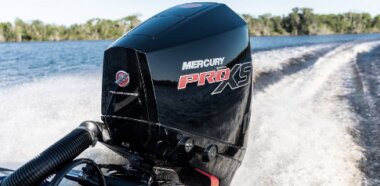
Suzuki DF9.9B Specifications
| Engine Model: Suzuki DF9.9B |
| Engine Type: 4-stroke 2-cylinder OHC gasoline outboard engine |
| Total Displacement: 20.1 cu.in (327 cc) |
| Rated Engine Power: 9.9 Hp (7.3 kW) at 5700 rpm |
| Fuel System: Multi-point sequential electronic fuel injection |
____________________________________________________________________________________
The Suzuki DF9.9B is a technologically advanced
portable outboard that sets new standards in its class. Its
groundbreaking Battery-Less Electronic Fuel Injection system operates
without the need for a battery, ensuring reliable starting and smooth
running performance in all conditions while shedding unnecessary weight.
The addition of Suzuki's Lean Burn Control technology optimizes the
air-fuel mixture across the operating range, delivering remarkable fuel
efficiency and reduced emissions.
The engine is available in multiple configurations including tiller or
remote steering, manual or electric start, and with manual or power trim
and tilt options. Built with Suzuki's advanced anti-corrosion system and
featuring an Easy Start recoil system with exceptionally light pull
effort, the DF9.9B offers user-friendly operation combined with
state-of-the-art engineering. It is an ideal power source for small
fishing boats, inflatables, and as a dependable auxiliary engine for
larger vessels.
Engine Model - Suzuki DF9.9B, DF9.9BE, DF9.9BR, DF15BT, DF9.9BTH
Engine Type - 4-stroke two-cylinder OHC gasoline outboard engine
Number of Cylinders - 2
Displacement - 327 cc (20.1 cu-in)
Cylinder Bore - 60.4 mm (2.38 in)
Piston Stroke - 57.0 mm (2.24 in)
Maximum Engine Power - 7.3 kW (9.9 hp)
Full Throttle Operating Range - 4700 - 5700 r/min
Idle Speed - 800 - 900 r/min
Fuel System Type - Multi-Point Sequential Electronic Fuel Injection
Fuel Pump Type - Integral with high-pressure pump, fuel cooler, and
vapor separator
Fuel Type - Unleaded gasoline (91 octane minimum)
Ignition System - Digital CDI
Cooling System - Water-cooled
Exhaust System - Through propeller hub
Starting System - Manual recoil or electric
Choke System - Automatic via EFI system
Gear Shift - Forward - Neutral - Reverse
Gear Ratio - 2.08:1
Steering System - Tiller Handle or Remote Control
Trim and Tilt System - Manual Trim and Tilt or Power Trim and Tilt
Transom Height (Short Shaft) - 381 mm (15 in)
Transom Height (Long Shaft) - 508 mm (20 in)
Transom Height (Extra Long Shaft) - 635 mm (25 in)
Dry Weight (Short Shaft, Manual) - 44.0 kg (96.9 lbs)
Dry Weight (Long Shaft, Manual) - 45.0 kg (99.1 lbs)
Dry Weight (Electric Start, Remote) - 48.0-49.0 kg (105.8-108.0 lbs)
Alternator Rating - 12V 6A or 12V 12A depending on model
The powerhead is constructed around an inline two-cylinder configuration
with a displacement of 327 cc. The engine is direct water-cooled with an
in-line 2-cylinder, 4-stroke cycle gasoline unit featuring SOHC valve
mechanism. The cylinder bore inside diameter measures 60.400-60.415 mm,
with a maximum permissible out-of-round of 0.050 mm. The piston skirt
diameter is 60.365-60.380 mm, resulting in a piston-to-cylinder
clearance of 0.0271-0.0425 mm.
The piston pin outside diameter is 15.995-16.000 mm, with a piston pin
bore inside diameter of 16.002-16.008 mm, providing a clearance of
0.002-0.013 mm. The connecting rod big end inside diameter is
29.025-29.034 mm, with a crank pin outside diameter of 28.989-29.000 mm,
resulting in an oil clearance of 0.025-0.045 mm. Connecting rod side
clearance at the big end is 0.100-0.250 mm.
The crankshaft journal outside diameter is 31.989-32.000 mm with an oil
clearance of 0.020-0.047 mm. Maximum crankshaft runout is 0.040 mm. The
piston rings include a top ring, second ring, and oil ring. The top ring
has a width of 1.02-1.04 mm and an end gap of 0.12-0.25 mm. The second
ring width is 1.21-1.23 mm with an end gap of 0.26-0.39 mm. Top ring
side clearance is 0.030-0.070 mm.
The cylinder head incorporates the SOHC valve train with two valves per
cylinder. The SOHC is mounted over the cylinder head and driven by the
crankshaft through a timing belt (cogged belt). Unlike conventional OHV
engines, this design has no push rods, allowing more direct valve
movement that follows crankshaft rotation without delay. The cylinder
head warp limit is 0.050 mm.
Minimum valve head thickness for both intake and exhaust valves is 0.50
mm. The intake valve stem outside diameter is 5.475-5.490 mm, while the
exhaust valve stem is 5.450-5.465 mm. Valve guide inside diameter for
both valves is 5.500-5.512 mm. Intake valve stem-to-guide clearance is
0.010-0.037 mm, and exhaust clearance is 0.035-0.062 mm. Valve seat
width for both intake and exhaust is 0.9-1.1 mm.
The valve spring free length is 33.16 mm. Intake cam height is
23.710-23.870 mm, while exhaust cam height is 23.530-23.690 mm. Camshaft
journal outside diameter is 24.959-24.980 mm for the upper journal and
22.959-22.980 mm for the lower, with an oil clearance of 0.020-0.062 mm.
Valve lash is set to 0.16-0.20 mm for both intake and exhaust valves.
The DF9.9B features a revolutionary Multi-Point Sequential Electronic
Fuel Injection system that operates without a battery, an industry first
in this Hp class. All-new components including an inline high-pressure
fuel pump, fuel cooler, vapor separator, fuel injectors, and a new
throttle body were designed to be as compact and lightweight as
possible. The system provides quicker starts, smoother running
performance, and superior acceleration in all operating conditions.
Suzuki's Lean Burn Control technology predicts fuel requirements based
on operating conditions and delivers the optimal air-fuel mixture to the
engine, resulting in remarkable fuel economy throughout the operating
range. A standard 12-liter (3.2 gallon) external fuel tank is included
with the engine. The engine is designed to run on unleaded gasoline with
a minimum octane rating of 91.
The lubrication system is a pressure-fed wet sump design utilizing a
trochoid-type cam-driven oil pump to ensure reliable oil delivery to all
critical engine components. This pressurised system reduces friction and
wear, enhancing engine longevity.
The engine includes a replaceable cartridge-style oil filter. Engine oil
capacity is 1.00 liter (1.05 quarts) of SAE 10W-30 or 10W-40 oil,
meeting API service classifications SG through SN. A low oil pressure
warning system protects the engine from operation with insufficient oil
pressure.
Engine temperature is regulated by a direct water-cooled system. Cooling
water is drawn into the engine through intakes on the gearcase and
circulated by a rubber impeller water pump. A thermostat maintains
optimal operating temperature for combustion efficiency and performance.
The system includes a fresh water flushing port, allowing owners to
easily flush cooling passages with fresh water after use in salt or
polluted water. An overheat warning system alerts the operator to
cooling system malfunctions. A tell-tale port provides visible
confirmation that the cooling system is operational.
| Mid Section and Lower Unit |
The mid-section houses the driveshaft and provides the mounting
interface to the transom bracket. The lower unit contains the gearcase,
which is filled with 0.25 liters (0.26 quarts) of Suzuki Outboard Motor
Gear Oil or GL5 SAE 90 gear oil.
The gears provide a reduction ratio of 2.08:1, optimizing propeller
speed for effective thrust. The shift mechanism enables smooth and
positive engagement of Forward, Neutral, and Reverse gears with a
forward-mounted gear shift lever. Exhaust gases are expelled through the
propeller hub for quieter operation.
Trim and tilt adjustments are available in both manual and power
configurations depending on model selection. Manual trim systems use a
pin in one of five adjustment positions on the transom bracket. Power
tilt models provide smooth tilting of the outboard with greater
convenience and improved easier operation.
A tilt release lever on manual models disengages the lock for tilting
the engine out of the water for beaching, trailering, or storage. Models
equipped with power tilt also feature five trim positions with tilt lock
pin. Shallow water drive settings are available on some models.
The DF9.B is designed to use three-bladed or four-bladed aluminum
propellers depending on model and application. The standard propeller
diameter is 235 mm (9.25 in). A wide range of propeller pitches is
available from 5 inches to 12 inches to accommodate different boat and
loading conditions.
Common pitch options include 8, 9, 10, 11, and 12 inches. Some models
come standard with a four-blade 10-inch diameter by 5-inch pitch
propeller. Selecting the correct pitch is crucial for allowing the
engine to operate within its recommended full-throttle RPM range of
4700-5700 for optimal performance and efficiency.
The short shaft model, designed for a 381 mm (15 in) transom, has a dry
weight of 44.0 kg (96.9 lbs) for manual start tiller models. The long
shaft model, for a 508 mm (20 in) transom, weighs 45.0 kg (99.1 lbs)
with manual start. Electric start remote control models weigh 48.0-49.0
kg (105.8-108.0 lbs) depending on shaft length.
Extra long shaft models for 635 mm (25 in) transoms are available with
electric start and power tilt, weighing approximately 58.0 kg (128 lbs).
An integrated carrying handle allows for convenient transport. Overall
dimensions vary by configuration, with compact design facilitating
storage.
Every 100 hours of operation or annually, the following tasks should be
performed: change engine oil, change gear oil, check spark plugs
(adjusting gap to 0.8-0.9 mm or 0.031-0.035 in), inspect breather and
fuel line, check low pressure fuel filter, inspect sacrificial anodes,
verify thermostat operation, check propeller nut and cotter pin, and
check battery condition on electric start models.
Every 200 hours, in addition to the 100-hour checks, the engine requires
replacement of the oil filter, inspection and adjustment of valve lash,
inspection of the timing belt, checking and adjusting idle speed, and
inspecting the water pump and its impeller.
Every 300 hours, the spark plugs should be replaced with NGK MR6K-9, and
the water pump impeller must be replaced to prevent cooling system
failure. Every 400 hours, the timing belt should be replaced and the
fuel filter should be replaced.
Cylinder head bolt (1st step) - 15 Nm (11 lb-ft)
Cylinder head bolt (Final step) - 30 Nm (21.7 lb-ft)
Cylinder head cover bolt - 10 Nm (7.2 lb-ft)
Conrod cap bolt - 10 Nm (7.2 lb-ft)
Flywheel nut - 90 Nm (65.0 lb-ft)
Camshaft pulley bolt - 10 Nm (7.2 lb-ft)
Timing pulley nut - 50 Nm (36.0 lb-ft)
Side cover screw - 5 Nm (3.6 lb-ft)
Spark plug - 10-12 Nm (7.5-9.0 lb-ft)
Tiller handle bolt - 23 Nm (16.5 lb-ft)
Tiller handle bracket bolt - 23 Nm (16.5 lb-ft)
Steering friction adjuster nut - 9 Nm (6.5 lb-ft)
Throttle grip screw - 3 Nm (2.1 lb-ft)
Driveshaft housing bolt - 23 Nm (16.5 lb-ft)
Clamp bracket shaft nut - 43 Nm (31.0 lb-ft)
Propeller nut - 18 Nm (13.0 lb-ft)
Gearcase bolt - 17 Nm (12.3 lb-ft)
Water pump case nut - 6 Nm (4.3 lb-ft)
Bearing housing bolt - 8 Nm (5.8 lb-ft)
Power unit mounting bolt - 23 Nm (16.5 lb-ft)
Intake manifold - 23 Nm (16.5 lb-ft)
Throttle body - 11 Nm (8.0 lb-ft)
Low pressure fuel pump bolt - 10 Nm (7.2 lb-ft)
Fuel delivery pipe bolt - 11 Nm (8.0 lb-ft)
Starter motor mounting bolt - 23 Nm (16.5 lb-ft)
The Suzuki DF9.9B is engineered for a wide variety of watercraft
applications. Its compact size and advanced features make it an ideal
primary power source for small fishing boats, aluminum or polyester
fishing boats, jon boats, dinghies, and inflatable craft including RIBs
for coastal waters or lakes. It is particularly well-suited for console
boats with heavier loads and open boats up to approximately 5 meters in
length.
The engine is also a popular and dependable choice as an auxiliary or
"kicker" motor for larger fishing boats or sailboats, providing
slow-speed trolling and maneuvering capability as well as a reliable
backup power source. With its 9.9 hp output and advanced EFI technology,
it is well-suited for recreational boaters and anglers seeking an
efficient, quiet, and reliable outboard for various water conditions.
The engine is saltwater rated and suitable for use in both freshwater
and saltwater environments when properly maintained.
____________________________________________________________________________________
| Outboard Engines Technical Specifications |
| Small Engines Technical Specifications |
| Car Engines Technical Specifications |
| Industrial Engines Technical Specifications |