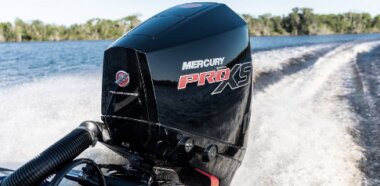
Yamaha 30HMH Specifications
| Engine Model: Yamaha 30HMH |
| Engine Type: 2-stroke 2-cylinder gasoline outboard engine |
| Total Displacement: 30.2 cu.in (496 cc) |
| Rated Engine Power: 30 Hp (22.1 kW) at 5500 rpm |
| Fuel System: Carburetor |
____________________________________________________________________________________
The Yamaha 30HMH is a 30-horsepower,
two-cylinder, two-stroke outboard engine renowned for its lightweight,
compact design and exceptional reliability. Built under Yamaha's
Customer Value (CV) badge, this model is engineered to deliver robust
power and enduring performance for a variety of small watercraft.
Its powerhead is based on a proven two-cylinder architecture, utilizing
a loop-charged scavenging system that creates a circular fuel flow for
efficient exhaust gas transfer and even distribution of the air-fuel
mixture, resulting in greater combustion efficiency and improved fuel
economy. The engine features a durable reed valve intake system and a
capacitor discharged ignition (CDI) that provides a strong spark and
precise timing to prevent plug fouling and enhance starting performance.
The Yamaha 30HMH is a 2-stroke, L-type (inline) engine featuring two
cylinders oriented horizontally. The total displacement measures 496 cc
(30.27 cu.in). The engine achieves a maximum prop shaft output of 22.1
kW, equivalent to 30 horsepower, at 5,000 rpm. The recommended full
throttle operating range is from 4,500 to 5,500 rpm, and the engine idle
speed is set between 1,050 and 1,150 rpm. The compression ratio is
7.0:1.
The fuel system relies on a carburetor, and the ignition is controlled
by a CDI (Capacitor Discharge Ignition) system. The alternator output is
rated at 12 volts and 80 W. For starting enrichment, the engine uses a
choke valve. The recommended spark plug is an NGK B8HS-10 or, for
reduced radio frequency interference, an NGK BR8HS-10. The cooling
system is a raw-water, thermostatically controlled design, drawing water
from the body of water the engine is operating in. Exhaust is expelled
through the propeller boss, contributing to quieter operation.
The cylinder block and powerhead are the core of the 30HMH's robust
design. The cylinder bore has an inside diameter of 72.000 to 72.020 mm
(2.8346 to 2.8354 inches). The cylinder head has a maximum allowable
warpage limit of 0.1 mm (0.0039 inch), which is a critical specification
for maintaining a proper seal and compression.
The pistons are precisely matched to the cylinders, with a piston
diameter of 71.935 to 71.960 mm (2.8321 to 2.8331 inches). The piston
pin, which connects the piston to the connecting rod, has an outside
diameter of 19.895 to 19.900 mm (0.7833 to 0.7835 inches).
The connecting rod small-end inside diameter measures 23.904 to 23.917
mm (0.9411 to 0.9416 inches), while the big-end inside diameter is
32.000 to 32.016 mm (1.2598 to 1.2605 inches). The big-end side
clearance is specified at 0.200 to 0.700 mm (0.0079 to 0.0276 inch). The
crankshaft is made from a specially hardened material for extended life,
and its crankpin diameter is 23.995 to 24.000 mm (0.9447 to 0.9449
inches).
The piston ring configuration includes two rings. The top ring has an
end gap of 0.20 to 0.35 mm (0.0079 to 0.0138 inch) and a side clearance
of 0.02 to 0.06 mm (0.0008 to 0.0024 inch). The second ring has an end
gap of 0.20 to 0.35 mm (0.0079 to 0.0138 inch) and a side clearance of
0.03 to 0.07 mm (0.0012 to 0.0028 inch).
The intake system utilizes reed valves, with a valve stopper height of
2.5 to 2.8 mm (0.098 to 0.110 inch) and a maximum allowable reed warp of
0.2 mm (0.008 inch). The scavenging system is of the loop-charge design,
optimizing fuel delivery and exhaust removal.
| Fuel System and Lubrication |
The fuel system is built around a carburetor that mixes air and fuel for
combustion. The lubrication system is a pre-mix type, requiring the
operator to mix two-stroke outboard motor oil with the fuel. The
recommended engine oil must be NMMA-certified TC-W3.
The correct fuel-oil mixture ratio is 50:1 during the break-in period
and for normal operation, though some sources indicate that superior
manufacturing techniques allow for a leaner 100:1 mixture at certain
speeds for reduced smoke and carbon buildup. The fuel used should be
regular unleaded gasoline.
The cooling system is a raw-water design, meaning it uses the
surrounding water to cool the engine. It is thermostatically controlled
to maintain optimal operating temperatures. A key feature is the
large-capacity, hard-chrome-plated water pump, which ensures a
sufficient flow of cooling water in various conditions, including muddy
or silty waters, to prevent engine overheating and wear. The system
includes a water passage that should be flushed with clean water after
operation in salt, turbid, or muddy water to prevent blockages.
| Mid Section and Lower Unit |
The mid section houses the exhaust passage and drive shaft, connecting
the powerhead to the lower unit. The lower unit contains the critical
reduction gears and propulsion components. The gear ratio is 2.08:1,
achieved with a pinion and forward gear combination of 27/13 teeth.
The reduction gear type is spiral bevel gears, and the clutch is a dog
clutch type for positive engagement. The gear shift positions are
forward, neutral, and reverse (F-N-R). The propeller shaft is of the
spline type, and the propeller direction, when viewed from the rear, is
clockwise.
The lower unit requires hypoid gear oil of API GL-4 SAE 90 grade. The
total gear oil capacity is 0.32 liter (0.34 US quart). A maintenance
schedule for the lower unit includes checking for leaks and changing the
gear oil at specified intervals.
The Yamaha 30HMH is equipped with a manual trim and tilt system, known
as the manual tilt method. This system allows the operator to adjust the
angle of the outboard relative to the transom to optimize boat
performance and handling in varying water conditions. The trim system
offers five distinct trim angle positions: 4.0, 8.0, 12.0, 16.0, and
20.0 degrees.
For shallow water navigation, the engine features a shallow water drive
capability, allowing it to be tilted up further. The maximum tilt-up
angle is 76.0 degrees, which is useful for beaching, launching, or
trailering the boat. The steering angle is 40.0 degrees to both port and
starboard.
Selecting the correct propeller is essential for achieving optimal
performance from the 30HMH. The engine is designed to work with a range
of propeller sizes to suit different boat loads and applications. All
recommended propellers share a diameter of 9-7/8 inches, with various
pitch options available to fine-tune engine rpm and boat speed.
The available propeller sizes include 9-7/8 x 8, 9-7/8 x 9, 9-7/8 x 10,
9-7/8 x 10-1/2, 9-7/8 x 11-1/4, 9-7/8 x 12, 9-7/8 x 13, and 9-7/8 x 14
inches. Yamaha offers genuine propellers, including the Alloy White F
Series, designed to deliver high-quality performance and durability.
The Yamaha 30HMH has a compact footprint. Its overall length is 843 mm
(33.2 inches), and its overall width is 399 mm (15.7 inches). The engine
is available in two shaft length configurations to match different boat
transom heights. The short shaft model has an overall height of 1,146 mm
(45.1 inches) and is designed for a transom height of 381 mm (15.0
inches).
The long shaft model has an overall height of 1,273 mm (50.1 inches) and
is intended for a transom height of 508 mm (20.0 inches). The dry weight
for the short shaft model is 53.0 kg (117 lbs), while the long shaft
model weighs slightly more at 54.5 kg (120 lbs).
After First 10 Hours: Check and adjust the carburetor and ignition
timing. Retighten all bolts and nuts. Every 50 Hours (3 months): Inspect
and clean the spark plugs. Check the fuel filter and clean if necessary.
Change the gear oil in the lower unit.
Every 100 Hours (6 months): Check the condition of the fuel system
components. Inspect the cooling water passage for blockages and clean
the entire system. Clean and adjust the spark plugs.
Every 200 Hours (1 year): Replace the spark plugs. Check the operation
of the choke valve and all control cables. Inspect the condition of the
sacrificial anodes, replacing if significantly eroded. Lubricate all
grease points.
Starter nut: 10 Nm (7.2 lb-ft)
Drive plate bolt: 15 Nm (11.1 lb-ft)
Starter mount bolt: 12 Nm (8.9 lb-ft)
Power unit mount bolt: 22 Nm (16.2 lb-ft)
Flywheel magnet nut: 140 Nm (103 lb-ft)
Reed valve stopper nut: 4.5 Nm (3.3 lb-ft)
Cylinder head bolt (1st step): 15 Nm (11.1 lb-ft)
Cylinder head bolt (2nd step): 27 Nm (19.9 lb-ft)
Crankcase bolt (1st step): 15 Nm (11.1 lb-ft)
Crankcase bolt (2nd step): 27 Nm (19.9 lb-ft)
Spark plug: 25 Nm (18 lb-ft)
Lower case mount bolt (nut): 37 Nm (27.3 lb-ft)
Cooling water inlet cover screw: 4 Nm (3.0 lb-ft)
Propeller nut: 35 Nm (25.3 lb-ft)
Propeller housing bolt: 11 Nm (8.1 lb-ft)
Steering bracket bolt: 11 Nm (8.1 lb-ft)
Float pin screw: 2 Nm (1.5 lb-ft)
Float chamber screw: 2 Nm (1.5 lb-ft)
The Yamaha 30HMH is a versatile outboard suited for a wide range of
small to medium-sized boats. Its lightweight and compact design makes it
an excellent choice for inflatable boats and rigid-hulled inflatable
boats (RHIBs) used for recreational boating, water rescue, and emergency
(flood control) operations. It is also a popular power option for jon
boats, skiffs, and small aluminum fishing boats, providing reliable and
efficient power for inland and coastal fishing.
Small pontoon boats and light-duty commercial craft, such as those used
in aquaculture or small-scale fishing, also benefit from the engine's
durability and power. Its shallow water drive capability makes it
particularly useful for operating in rivers and areas with variable
water depths.
____________________________________________________________________________________
| Outboard Engines Technical Specifications |
| Small Engines Technical Specifications |
| Car Engines Technical Specifications |
| Industrial Engines Technical Specifications |