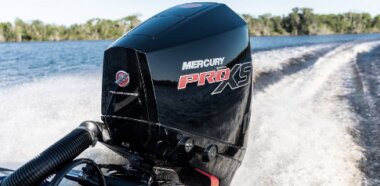
Mercury 200 L6 Verado Specifications
| Engine Model: Mercury Verado 200 L6 |
| Engine Type: 4-stroke inline 6-cylinder gasoline outboard engine |
| Total Displacement: 159 cu.in (2.6 L) |
| Rated Engine Power: 200 Hp (149 kW) at 6400 rpm |
| Fuel System: Sequential Multi-Point Electronic Fuel Injection (EFI) |
____________________________________________________________________________________
The Mercury Verado 200 L6 represents a
distinctive approach in the outboard market, utilizing a supercharged
inline-six architecture to deliver robust power and smooth operation.
This engine is engineered to provide the low-end torque and responsive
acceleration of a larger-displacement two-stroke within the refined,
quiet framework of a modern four-stroke.
It is a model that prioritizes a premium boating experience through
advanced engineering and seamless integration with Mercury's digital
control systems. A key feature is its standard electro-hydraulic power
steering, which eliminates mechanical steering feedback and effort,
offering an automotive-like helm experience. The 200 L6 is part of a
revered engine family, marking a significant milestone in Mercury's
history as a revolutionary outboard platform.
Engine Type: Supercharged Inline 6-cylinder, 4-stroke.
Rated Power: 200 HP (149 kW).
Displacement: 2.6 Liters (159 CID).
Bore and Stroke: 3.23 x 3.23 inches (82 x 82 mm).
Induction: Supercharged with computer-controlled electronic boost
pressure adjustment to optimize fuel mixture across the entire rev
range.
The system is also equipped with charge air cooling.
Full Throttle RPM: 5800-6400.
Fuel System: Sequential Multi-Port Electronic Fuel Injection (EFI).
Fuel Requirements: Minimum 91 RON (approximately 87-89 Octane).
Alternator Output: 70 amp / 882 watt, belt-driven.
Steering System: Electro-hydraulic power steering, standard equipment.
Control System: SmartCraft Digital Throttle and Shift (DTS) for precise,
effortless shifting and throttle control. Gearcase Ratio: 1.85:1.
Gearcase Options: Available with either a 4.8-inch or a 5.44-inch
diameter gearcase.
Starting System: SmartStart Electric, which ensures consistent starts by
automatically advancing the starter motor engagement.
Ignition System: SmartCraft PCM (Powertrain Control Module) Digital
Inductive ignition.
The foundation of the Mercury 200 L6 Verado is its inline 6-cylinder
powerhead. The closed-deck cylinder block is precision machined to
provide a rigid platform for the rotating assembly. The square bore and
stroke dimensions of 3.23 inches (82 mm) contribute to the engine's
inherent smoothness and torque characteristics.
The cylinder head is a sophisticated component designed for
high-performance four-stroke operation. It houses the valvetrain, which
is configured for efficient intake and exhaust flow. The valves are
actuated by a durable overhead camshaft design, ensuring precise timing
and reliability under the stress of supercharged induction.
The fuel system is a sophisticated, fully electronic setup. It utilizes
Sequential Multi-Port Electronic Fuel Injection, where individual
injectors deliver fuel precisely before each intake valve. This method
ensures optimal atomization and cylinder-specific fueling for maximum
efficiency and power. The entire process is managed by the main engine
control unit, which dynamically adjusts fuel delivery and spark timing.
The system is designed to work in concert with the supercharger, using
electronic boost pressure control to maintain the ideal air-fuel mixture
at every throttle position and engine speed, from idle to wide-open
throttle. This integration delivers crisp throttle response and
optimized fuel economy during cruising, as evidenced by sea trials
showing a consumption of 52 liters per hour at a 4500 rpm cruising
speed.
The lubrication system is a conventional automotive-style wet sump
design, but it is engineered to handle the specific demands of marine
operation and supercharged forces. A high-capacity, gear-driven oil pump
circulates engine oil throughout the powerhead to all critical
components, including the crankshaft and connecting rod bearings, the
supercharger gears, and the valve train.
The system includes a full-flow oil filter to remove contaminants. The
engine's oil capacity is designed to support extended service intervals,
although regular checks are essential for long-term durability.
Cooling for the high-output Verado 200 is managed by a
positive-displacement water pump, typically located in the lower unit.
This pump draws water from outside the boat and pushes it through a
closed cooling circuit within the powerhead. The system uses a
thermostat to regulate the engine's operating temperature, allowing for
rapid warm-up and then maintaining a consistent temperature for
efficient combustion and long engine life.
The pressurized water circulates through internal passages in the
cylinder block and cylinder head, absorbing heat before being exhausted.
The charge air cooler, an integral part of the induction system, also
uses this seawater to reduce the temperature of the compressed air from
the supercharger, increasing its density for more powerful combustion.
| Mid Section and Lower Unit |
The mid-section, or pedestal, houses the driveshaft that transmits power
from the engine to the gearcase. It is designed to provide robust
mounting for the powerhead and integrate the power trim and tilt
cylinders. It also incorporates the isolator mounts that reduce
vibration and noise transfer to the boat. The lower unit contains the
gearcase, which is available in two diameters: a standard 4.8-inch
version and a heavy-duty 5.44-inch version.
The gearcase houses the forward, neutral, and reverse gears with a ratio
of 1.85:1. It is fitted with a Flo-Torq Soft Shift Rubber Hub system,
which dampens the engagement of the clutch dog for smooth, virtually
clunk-free gear changes. The design of the lower unit and gearcase is
critical for directing the propeller thrust efficiently and providing
the necessary hydrodynamic lift for the boat.
The power trim and tilt system is a heavy-duty hydraulic unit, fully
integrated into the mid-section. It allows the operator to adjust the
angle of the outboard relative to the transom. During acceleration,
trimming the drive down helps the boat rise onto plane by keeping the
propeller thrust vector low.
Once on plane, trimming the drive up optimizes the hull angle for better
speed and fuel efficiency. The system also provides a high tilt range
for the engine to be raised completely out of the water for trailering,
launching, or when the boat is at rest, protecting the lower unit from
marine growth and corrosion.
The Mercury 200 L6 Verado is designed to turn a range of
high-performance propellers to suit different boat types and
applications. Mercury typically fits these engines with advanced
stainless steel propellers to fully utilize the power and torque.
In one documented sea trial on a 2500kg Beneteau Antares 8 OB, the boat
was equipped with an Enertia 14.7 x 16-inch propeller, demonstrating
excellent performance. The choice of propeller size - diameter and pitch
- will vary based on boat weight, hull design, and the intended use,
such as maximizing top speed or improving load-carrying capability.
Dry Weight: The lightest model of the Mercury Verado 200 L6 has a dry
weight of 648 lbs (294 kg). This weight places it above four-cylinder
competitors but contributes to its structural rigidity and the robust
feel of the package.
Shaft Length Options: Standard configurations are available, with a
common length being 20 inches for typical transoms. Other lengths, such
as 25 inches, are also part of the model lineup.
Engine Oil and Filter: Recommended for change annually or after every
100 hours of operation, whichever comes first. Fuel System: The system
includes a water-separating fuel filter that should be replaced
periodically. Given the sophisticated fuel injection, clean fuel is
critical.
Gearcase Lubricant: The oil in the lower unit gearcase should be checked
seasonally and replaced according to the maintenance schedule,
especially before winterization. Cooling System: The water pump impeller
is a wear item and should be inspected and replaced at recommended
intervals to prevent overheating. Anodes: Sacrificial anodes on the
engine and lower unit must be checked regularly and replaced when eroded
to protect against galvanic corrosion in saltwater.
Flywheel Nut: 100-120 lb-ft, 135-163 Nm.
Long Main Bolt
Step 1 = 20 lb.ft, 27 Nm
Step 2 = 55 lb.ft, 41 Nm
Step 3 = plus 270 deg
Cylinder Block Perimeter Bolts 26 lb.ft, 35 Nm
Connecting Rod Bolts
Step 1 = 11 lb.ft, 15 Nm
Step 2 = 22 lb.ft, 30 Nm
Step 3 = plus 90 deg
Cylinder Head Perimeter Bolts
M8X60 = 21 lb.ft, 28 Nm
M6X40 = 11 lb.ft, 8 Nm
The Mercury Verado 200 L6 is a versatile power option suited for a broad
spectrum of boat types. Its power-to-weight ratio and torque-rich
delivery make it an excellent choice for a wide variety of applications.
It is well-suited for powering off-shore boats, often in multi-engine
configurations, as well as for single-engine applications on deep-V
hulls. In freshwater, it is a premium choice for serious fishermen on
bass boats and multi-species crafts.
The engine is also a popular selection for high-end pontoon boats, where
its smoothness and quiet operation enhance the luxury experience. Its
refinement and power are equally valued on classic cruising boats like
the Beneteau Antares, where it provides a planted, confident feel and
seamless acceleration. The engine's design also lends itself to
commercial and governmental use, where officials require perfect power,
efficiency, and rapid response.
____________________________________________________________________________________
| Outboard Engines Technical Specifications |
| Small Engines Technical Specifications |
| Car Engines Technical Specifications |
| Industrial Engines Technical Specifications |