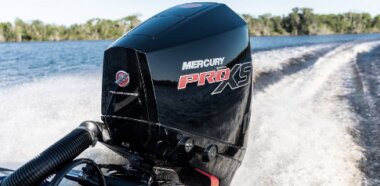
Mercury 25 Bigfoot Specifications
| Engine Model: Mercury Bigfoot 25 |
| Engine Type: 4-stroke 2 or 3 cylinder gasoline outboard engine |
| Total Displacement: 30.4 cu.in (498 cc) or 32.1 cu.in (526 cc) |
| Rated Engine Power: 25 Hp (18.7 kW) at 6000 rpm |
| Fuel System: Carburetor or electronic fuel injection (EFI) |
____________________________________________________________________________________
The Mercury Bigfoot 25 stands apart from
standard 25 hp outboards through its robust construction and
purpose-built design for moving heavy loads. Its defining characteristic
is the substantially larger lower unit, originally developed for the
unique demands of pontoon boats where turbulent water from twin hulls
requires a larger propeller and stronger gearcase to maintain bite and
thrust. This engine delivers reliable, fuel-efficient four-stroke power
with the torsional force needed to bring larger, heavier vessels onto
plane.
Later models benefit from Electronic Fuel Injection (EFI), ensuring
effortless starting and smooth operation across all conditions. The
engine is available with advanced Mercury tiller handles that offer
ergonomic adjustments for left or right-hand operation and adjustable
tiller angles for improved control and leverage. Its design prioritizes
rugged dependability and low-end grunt for commercial and heavy
recreational use.
The Mercury 25 Bigfoot is defined by performance parameters and features
that cater to high-load scenarios, differentiating it from standard 25
hp offerings.
Maximum Power Output: 25 Hp (18.7 kW) at the propeller shaft.
Full Throttle Operating Range: 5500 to 6000 RPM.
Fuel System: Later model years feature Electronic Fuel Injection (EFI)
with no-battery-required operation on manual start models, providing
reliable starting in any weather. Earlier models may utilize a
carburetor.
Ignition System: Digital CDI (Capacitor Discharge Ignition) with
electronic spark advance for precise timing control. Alternator Output:
On electric start models, a 15-amp (189-210 watt) alternator provides
power for battery charging and operating basic electronics.
Compatible Fuel: Unleaded regular gasoline with a minimum octane rating
of 87 (R+M/2) or 90 RON. Fuel may contain up to 10% ethanol.
Steering: Tiller handle and remote steering configurations to suit
various boat applications.
Starting: Offered with either dependable electric start or a manual
start system.
The foundation of the Mercury Bigfoot 25 varies by production year, with
both 2-cylinder and 3-cylinder configurations having been produced to
deliver 25 Hp. Configuration: Inline, available as a 2-cylinder or a
3-cylinder design depending on the model year.
Displacement: Engine displacement varies by model year and cylinder
count. Known displacements include 498 cc (30.4 cubic inches) and 526 cc
(32.1 cubic inches). A 3-cylinder version with a displacement of 526 cc
(32.1 cubic inches) has also been produced.
Bore and Stroke: For the 2-cylinder 498 cc engine, the bore is 65 mm
(2.56 inches) and the stroke is 75 mm (2.95 inches). Bore and Stroke:
For the 3-cylinder 526 cc engine, the bore is 61 mm (2.4 inches) and the
stroke is 60 mm (2.4 inches).
Engine Type: Four-stroke, providing clean operation, quiet running, and
excellent fuel economy without the need for pre-mixing fuel and oil.
The cylinder head assembly is designed for efficient gas exchange and
durability, contributing to the engine's smooth power delivery and
overall efficiency.
Valvetrain Design: Single Overhead Camshaft (SOHC) configuration for
precise valve control and reduced maintenance. The valvetrain is
designed to be maintenance-free, eliminating the need for periodic valve
adjustments. Valves per Cylinder: Two valves per cylinder.
The fuel system on later models of the Mercury 25 Bigfoot represents a
significant technological advancement over traditional systems,
providing enhanced reliability and performance.
Induction System: Modern iterations utilize Electronic Fuel Injection
(EFI), which precisely meters fuel for optimal combustion, resulting in
effortless starting, immediate throttle response, and superior fuel
efficiency across the entire RPM range. A key feature of the EFI system
is its ability to operate without a battery on manual start models,
providing dependable performance in remote areas.
Fuel Delivery: An electric or mechanical fuel pump, depending on the
specific model and starting system, delivers fuel from the tank to the
injector or carburetor.
Recommended Fuel: Minimum 87-octane unleaded petrol is specified to
ensure proper combustion and prevent engine knocking.
The four-stroke design incorporates a self-contained, high-pressure
wet-sump lubrication system ensuring all moving parts are properly oiled
for long-term durability. System Type: Wet sump, with engine oil stored
in a sump within the oil pan.
Oil Capacity: The engine holds 2.8 to 3.0 liters (3.0 quarts) of engine
oil. Recommended Oil: Mercury FourStroke Marine Oil of the appropriate
viscosity for the operating climate is the specified lubricant for
optimal protection and performance. Maintenance Feature: The engine
features a no-leak oil change system for cleaner and easier maintenance.
To manage engine temperature under varying loads and conditions, the
Mercury Bigfoot 25 uses a positive displacement water pump for raw water
cooling. System Type: Thermostat-controlled water cooling, drawing
outside water through an intake to cool the engine.
Core Components: A rubber-impeller water pump, driven by the driveshaft,
pulls water from the lake or ocean. A thermostat regulates the flow to
maintain the engine at its optimal operating temperature for efficiency
and longevity.
| Mid Section and Lower Unit |
The mid-section houses the exhaust and driveshaft, while the lower unit
is the defining feature of the Bigfoot model, designed for maximum
thrust and durability.
Gearcase Design: The Bigfoot gearcase is significantly larger and more
robust than a standard 25 hp lower unit. It is overbuilt and shares
design architecture with gearcases found on larger outboards, such as
40-50 hp models, to withstand higher thrust loads and utilize a larger
propeller.
Gear Ratio: The gear ratio is specifically selected for high thrust
applications at 2.40:1. This lower ratio (numerically higher) allows the
engine to spin a larger propeller at lower RPMs, generating greater
torque for pushing heavy loads.
Gear Shift: Standard forward-neutral-reverse (F-N-R) shifting operation.
Exhaust: Through-propeller exhaust release for quieter operation and
reduced back pressure. Gearcase Lubrication: The gearcase holds
dedicated high-grade marine gear lubricant. Regular inspection and
replacement are part of standard maintenance.
The engine is available with different systems for adjusting the
engine's angle relative to the transom, ranging from manual assist to
full hydraulic control.
System Type: Depending on the model year and configuration, the Bigfoot
25 may be equipped with either a gas-assist manual tilt mechanism or an
integrated power trim and tilt system.
Power Trim: Allows the operator to adjust engine angle while underway to
optimize boat attitude, improve fuel efficiency, and enhance ride
quality.
Power Tilt: Lifts the engine out of the water for trailering, launching,
beaching, or shallow water anchoring. This feature is a significant
advantage for small boats and heavy loads.
Shallow Water Capability: The tilt function enables operation in very
shallow water by raising the engine and propeller to avoid striking the
bottom.
Propeller Design: The Bigfoot gearcase is optimized for a larger
diameter propeller compared to a standard 25 hp engine. This larger
blade area allows the engine to transfer more of its torque into usable
thrust, providing better grip and control for heavy boats.
Compatible Propeller Series: The engine is compatible with specialized
propeller lines such as the Mercury Trophy Sport, a four-blade stainless
steel prop designed specifically for Bigfoot and Command Thrust
outboards in this power class. This design helps lift boats on plane
quickly and improves handling.
Propeller Selection: The correct propeller must allow the engine to
operate within its recommended full-throttle RPM range of 5500-6000 when
the boat is normally loaded. Various pitch options are available to
fine-tune performance for specific applications.
Shaft Length is vailable in two primary
configurations:
Short shaft: 381 mm (15 in), designed for boats with a transom height of
381 mm.
Long shaft: 508 mm (20 in), designed for boats with a standard transom
height of 508 mm.
Dry Weight: The weight varies slightly by model year, shaft length, and
starting system. The dry weight range is 79 to 81 kg (175 to 178 lbs).
Some sources list weights from 60 kg (132 lbs) for basic tiller models
to 66 kg (146 lbs) for models with additional features.
Routine Maintenance (Every 100 Hours /
Annually):
Change the engine oil and replace the oil filter.
Replace the gearcase lubricant.
Inspect and clean or replace the spark plugs.
Check and clean the fuel filter.
Inspect the fuel system for leaks or deterioration.
Check and clean the anti-corrosion anodes, replacing them if they are
more than 50% eroded.
Lubricate all moving parts and pivot points.
Critical Maintenance Items:
Water Pump Impeller: Must be replaced every 3 to 5 years or
approximately every 300 hours, regardless of apparent condition, to
prevent overheating due to impeller failure.
Valve Clearance: The SOHC valvetrain is designed to be maintenance-free,
requiring no periodic valve adjustments.
Timing Belt: If equipped, should be inspected for cracks and wear at
regular intervals.
Periodic Checks:
Battery condition and electrolyte levels on electric start models.
Propeller condition for dings, cracks, or fishing line, and ensure the
cotter pin is in place.
Engine mounting hardware for correct torque.
Operation of the trim/tilt or gas-assist lift, checking hydraulic fluid
level where applicable.
Cylinder Head Bolts: final torque of 29-33 Nm (21-24 lb-ft).
Spark Plugs: 27 Nm (20 lb-ft).
Propeller Nut: 40 Nm (30 lb-ft).
Gearcase Mounting Nuts: 40 Nm (30 lb-ft).
Engine Mounting Bolts (to transom): 55-60 Nm (41-44 lb-ft).
The high-thrust characteristics of the Mercury Bigfoot 25 make it an
ideal power source for a specific range of heavier boat types where
standard outboards would struggle.
Pontoon Boats: The engine was originally developed with this application
in mind. Its larger gearcase and high-torque gearing provide the
necessary thrust to efficiently propel pontoon boats, overcoming the
drag and turbulent water created by twin hulls.
Heavy Work Boats: Its robust construction and torque make it suitable
for small commercial workboats, skiffs, and utility vessels used for
fishing, hunting, or light-duty hauling where reliability and pulling
power are paramount.
Auxiliary Power for Sailboats: The high-thrust propeller and durable
lower unit are well-suited for use as auxiliary power on smaller
sailboats, providing dependable power in varying conditions.
Consideration for Light Fishing Boats: While physically compatible, the
Bigfoot model is not optimized for light, planing fishing boats. Its
larger lower unit creates more drag, and propeller selection to achieve
high speed on a light hull may be limited. A standard gearcase 25 hp
model is more appropriate for such applications.
____________________________________________________________________________________
| Outboard Engines Technical Specifications |
| Small Engines Technical Specifications |
| Car Engines Technical Specifications |
| Industrial Engines Technical Specifications |