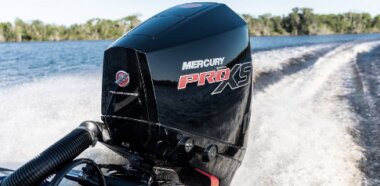
Yamaha F50HET Specifications
| Engine Model: Yamaha F50HET |
| Engine Type: 4-stroke inline 4-cylinder SOHC 8-valve gasoline outboard engine |
| Total Displacement: 60.8 cu.in (996 cc) |
| Rated Engine Power: 50 Hp (36.8 kW) at 5500 rpm |
| Fuel System: Electronic Fuel Injection (EFI) |
____________________________________________________________________________________
The Yamaha F50HET is a 50-horsepower,
four-stroke outboard engine that represents a significant advancement in
outboard technology, offering the power and smoothness of a
multi-cylinder engine in a package suitable for a wide range of boats.
As part of Yamaha's acclaimed midrange series, this model combines a
1.0-liter powerhead with electronic fuel injection to deliver
exhilarating performance, serious torque in the mid-ranges, and valuable
fuel efficiency.
The F50HET is distinguished by its electric start system, remote control
steering, and power trim and tilt, providing operators with effortless
command and the ability to precisely adjust the boat's attitude for
optimal handling and economy. Its four-stroke design ensures cleaner
operation with reduced emissions and noise compared to traditional
two-stroke counterparts, making it an environmentally conscious choice
for recreational and semi-commercial applications alike.
The Yamaha F50HET is a 4-stroke, Single Overhead Camshaft (SOHC), inline
4-cylinder engine featuring an 8-valve configuration. The total
displacement is 996 cc (60.8 cu.in), achieved through a bore and stroke
of 65.0 mm (2.56 inches) and 75.0 mm (2.95 inches), respectively. It
produces a maximum prop shaft output of 36.8 kW, equivalent to 50
horsepower, at 5,500 rpm. The engine has a full throttle operating range
of 5,000 to 6,000 rpm. The engine family and its certified emission
levels are detailed on a label affixed to the engine's bottom cowling.
The powerhead is built upon a robust cylinder block designed for
longevity and smooth operation. The cylinder head incorporates a Single
Overhead Camshaft (SOHC) operating four valves per cylinder - two intake
and two exhaust - for optimized breathing and combustion efficiency.
Precise valve timing is maintained by a timing belt and sprocket system,
which must be carefully set with the N1 piston at Top Dead Center of the
compression stroke, aligning the "1" mark on the driven sprocket with
the corresponding mark on the cylinder head.
The valve clearances are critical for performance and must be maintained
within specified ranges. The intake valve clearance is set to 0.15-0.25
mm (0.006-0.010 inches), while the exhaust valve clearance is set to
0.25-0.35 mm (0.010-0.014 inches). The camshaft and crankshaft are
precision components; special tools such as a crankshaft holder are
required to prevent rotation and damage when loosening or tightening the
drive sprocket nut or flywheel nut.
The fuel system is a sophisticated Electronic Fuel Injection (EFI)
system, which ensures cleaner performance, super-efficient fuel
consumption, and impressive power delivery across the entire rpm range.
This system automatically adjusts the fuel mixture for varying
conditions, eliminating the need for manual choke adjustments. The Prime
Start™ system provides effortless starting, comparable to starting an
automobile.
The engine operates on regular unleaded gasoline with a minimum octane
rating of 86. A standard remote fuel tank has a capacity of 25.0 liters
(6.6 US gallons), though the engine can be connected to larger built-in
boat tanks. The EFI system includes various sensors and components that
require periodic inspection for loose connections or damage.
The F50HET utilizes a wet sump lubrication system, meaning engine oil is
contained within a sump in the powerhead. The recommended engine oil is
high-quality 4-stroke outboard motor oil, with Yamalube being the
preferred brand. Acceptable oil types include SAE 10W-30 or 10W-40
viscosities that meet API service classifications SE, SF, SG, SH, SJ, or
SL.
The total engine oil capacity, including the filter, is 1.9 liters (2.0
US quarts). Changing the engine oil is a routine maintenance procedure
that must be performed with the engine warm for complete drainage,
followed by proper disposal of the used oil. The procedure involves
removing the drain screw and gasket, allowing the oil to drain
completely, and then refilling through the oil filler hole after
reinstalling the drain plug with a new gasket.
Cooling is managed by a raw-water system that circulates water through
passages in the engine block and cylinder head. A water pump, driven by
the drive shaft, draws water from outside the boat and forces it through
the engine to maintain optimal operating temperatures.
The system includes a thermostat that regulates water flow, allowing the
engine to warm up quickly and maintain a consistent temperature. A pilot
water outlet on the engine exterior provides a visual indication that
the water pump is functioning and cooling water is circulating properly.
Before each use, operators must verify that this outlet is not clogged
and that a steady stream of water is emitted once the engine is started.
| Mid Section and Lower Unit |
The exhaust system is designed to expel gases through the propeller hub
for quieter operation and reduced back pressure. The gear shift
positions are forward, neutral, and reverse. The gear ratio is 1.85:1,
derived from a 24/13 gear set. The reduction gear type is spiral bevel
gear, and the clutch is a dog type, providing positive engagement.
The propeller shaft utilizes a spline drive system for secure propeller
mounting, and the propeller rotation, when viewed from the rear, is
clockwise in forward gear. The gear case requires hypoid gear oil
meeting API GL-4 SAE 90 standards, with a total capacity of 0.43 liters
(0.45 US quarts). When draining the gear oil, it should be inspected for
water droplets or metallic particles, as a milky appearance indicates
water intrusion requiring immediate seal replacement.
The engine is equipped with a Wide Range Power Trim and Tilt system,
providing full, relaxed control over the engine's angle relative to the
transom. The trim angle is adjustable through a range of -4 to 20
degrees, allowing operators to optimize boat attitude for acceleration,
fuel economy, and ride comfort under varying load and water conditions.
The tilt-up angle is 69 degrees, enabling shallow water operation and
easy trailer-ing or beaching.
The system also features a Shallow Water Drive capability, allowing the
engine to be quickly tilted and operated at a shallower angle for safe
navigation through very shallow water without striking the bottom. An
optional Tilt Limiter system can be installed to prevent the engine from
tilting beyond a preset point when operating in reverse or around
obstacles.
Selecting the correct propeller is essential for achieving optimal
engine performance within the recommended full throttle operating range.
The Yamaha F50HET utilizes a spline drive system and is designed to run
with a wide selection of aluminum and stainless steel propellers. While
specific propeller part numbers vary by application and performance
goals, common sizes for this engine platform include various three-blade
configurations ranging in pitch.
The appropriate propeller allows the engine to operate at or near the
top of its 5,000-6,000 rpm full throttle range when the boat is properly
loaded. Propeller markings indicate the diameter and pitch in inches;
for example, a propeller marked "11-1/4 x 12" indicates an 11.25-inch
diameter and 12-inch pitch.
The overall length of the outboard is 698 mm (27.5 inches), and its
overall width is 386 mm (15.2 inches). The overall height for the long
shaft model, designated for a 20-inch transom, is 1,435 mm (56.5
inches), with a corresponding transom height of 527 mm (20.7 inches).
The dry weight for the long shaft version is 113 kg (249 lbs),
reflecting the robust construction and four-stroke architecture of the
powerhead.
Routine maintenance is essential for optimal performance and longevity.
The engine is equipped with a TCI (Transistor Controlled Ignition)
ignition system, which provides precise spark timing without moving
parts for reliable, maintenance-free operation. The alternator output is
a robust 12V - 16A system complete with a rectifier/regulator to
maintain proper battery charging.
The standard spark plug for the F50HET model is an NGK DPR6EB-9. The
spark plug gap must be maintained between 0.8 and 0.9 mm (0.031 to 0.035
inches). When installing spark plugs, the threads must be clean, and the
plug should be torqued to specification. If a torque wrench is not
immediately available, a new plug can be tightened 1/2 turn past
finger-tight, while a reused plug requires only 1/12 turn past
finger-tight.
The maintenance schedule includes key services at initial break-in
(first 10 hours), 50 hours (3 months), 100 hours (6 months), and annual
200-hour intervals. Items requiring periodic attention include the valve
clearance, which must be inspected and adjusted by qualified personnel
using feeler gauges. Inspecting the idle speed is a procedure that must
be performed with the engine in the water or a test tank after it has
fully warmed up, using a diagnostic tachometer if the boat is not so
equipped.
The engine is compatible with Yamaha's digital network gauges, allowing
operators to monitor critical engine parameters in real time. A Fresh
Water Flushing system is integrated into the design, facilitating easy
removal of salt and debris after operation in marine environments.
Adhering to correct torque specifications is critical during assembly
and maintenance to ensure proper sealing, component retention, and safe
operation. Critical fasteners require precise torquing, often in
specific sequences or stages. The spark plug must be torqued to 17 Nm
(12.5 lb-ft) to ensure proper seating without damaging the cylinder head
threads.
The propeller nut, which secures the propeller to the propeller shaft,
requires 34 Nm (25 lb-ft). The engine oil drain plug must be tightened
to 27 Nm (20 lb-ft) to prevent leaks while allowing future removal. The
oil filter requires 18 Nm (13.5 lb-ft) for proper sealing against its
mounting surface.
When torquing cylinder head bolts, a precise two-stage sequence must be
followed, with initial torquing to 23 Nm (17 lb-ft) followed by a final
pass at 47 Nm (34 lb-ft) in the specified order. The flywheel nut is a
critical fastener torqued to 110 Nm (80 lb-ft) and requires the use of a
flywheel holder tool to prevent crankshaft rotation during tightening or
loosening. Crankcase bolts are tightened in stages, with smaller M6
fasteners receiving 6 Nm (4.3 lb-ft) initially and 12 Nm (8.7 lb-ft)
finally.
The Yamaha F50HET is intended for use on boats where the total
horsepower does not exceed the vessel's maximum rated power capacity, as
indicated on the boat's capacity plate. Its 50-horsepower output,
electric start, remote steering, and power trim and tilt make it
suitable for a wide range of medium-sized craft, including aluminum
fishing boats, utility skiffs, pontoons, small center-console vessels,
and as auxiliary power for larger sailboats.
The long shaft configuration is specifically designed for boats with a
20-inch transom. The engine's lightweight design relative to its power
output and displacement makes it particularly attractive for vessels
where weight distribution is a concern. It is equally at home in
freshwater lakes and coastal saltwater environments, thanks to its
corrosion-resistant engineering.
The optional Yamaha Customer Outboard Protection (Y-COP) system adds an
extra layer of security against unauthorized use. Proper installation,
including correct remote control cable adjustment and battery selection,
is essential to ensure safe handling and prevent loss of control. As
with all outboards, operators must always ensure the engine stop switch
lanyard is attached to a secure part of their clothing or life jacket.
____________________________________________________________________________________
| Outboard Engines Technical Specifications |
| Small Engines Technical Specifications |
| Car Engines Technical Specifications |
| Industrial Engines Technical Specifications |