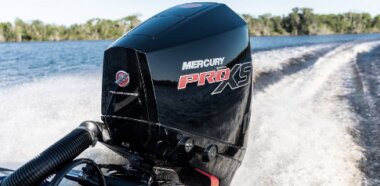
Mercury 60 Jet Specifications
| Engine Model: Mercury Jet 60 |
| Engine Type: 4-stroke inline 4-cylinder gasoline outboard engine |
| Total Displacement: 60.8 cu.in (995 cc) |
| Rated Engine Power: 60 Hp (45 kW) at 6000 rpm |
| Fuel System: Electronic Fuel Injection (EFI) |
____________________________________________________________________________________
The Mercury Jet 60 transforms the reliable 60hp
four-stroke powerhead into a shallow-water navigation tool by
eliminating the protruding lower unit and propeller entirely. Instead,
it utilizes an impeller-based jet drive that draws water through an
intake grill on the bottom of the engine and expels it at high velocity
to generate thrust. This design permits operation in water depths of
just a few inches, as there are no underwater projections to strike
submerged obstacles.
The engine is built upon a 995cc inline four-cylinder foundation
featuring Electronic Fuel Injection (EFI) for crisp throttle response
and reliable starting. It incorporates Mercury's Smart Start electric
starting system, which prevents starter engagement at high RPM, and a
powerful 35-amp alternator. The jet drive configuration includes a
reverse gate system that redirects the water stream for reverse
operation. While jet drives sacrifice some low-end thrust compared to
propellers, they offer unparalleled protection and peace of mind in
shallow, debris-filled waters.
Maximum Power Output: 60 Hp (45 kW) at the pump shaft.
Full Throttle Operating Range: 5000 to 6000 RPM.
Engine Type: Inline 4-cylinder, four-stroke.
Displacement: 995 cc (60.8 cubic inches).
Bore and Stroke: 65 mm (2.56 inches) bore and 75 mm (2.95 inches)
stroke.
Fuel System: Electronic Fuel Injection (EFI) with SmartCraft ECM 07
Digital Inductive ignition.
Alternator Output: 35 A (441 W), providing substantial charging capacity
for electronics and battery maintenance.
Starting System: Smart Start Electric, which prevents starter engagement
if the throttle is not in the neutral/idle position.
Steering: Compatible with Big Tiller or remote mechanical and hydraulic
steering systems.
Compatible Fuel: Unleaded regular gasoline with a minimum octane rating
of 87, containing up to 10% ethanol.
The foundation of the Mercury Jet 60 is a robust and
precision-engineered inline four-cylinder block designed for longevity
and smooth operation. Configuration: Inline 4-cylinder. Displacement:
995 cc (60.8 cubic inches). Bore and Stroke: The cylinder bore is 65 mm
(2.56 inches) and the piston stroke is 75 mm (2.95 inches).
Engine Type: Four-stroke, which provides cleaner operation, quieter
running, and superior fuel economy compared to two-stroke counterparts,
while eliminating the need for pre-mixing fuel and oil.
The cylinder head assembly is designed for efficient gas exchange,
contributing to the engine's smooth power delivery and overall
efficiency. Valvetrain Design: Single Overhead Camshaft (SOHC)
configuration with two valves per cylinder.
Valves per Cylinder: Two, resulting in a total of eight valves for the
engine. Fuel Induction: The valvetrain supports the advanced Electronic
Fuel Injection (EFI) system, ensuring an optimal air-fuel mixture is
delivered directly to each intake port.
The fuel system is a central feature of the Mercury 60 Jet, utilizing
advanced electronic controls to provide enhanced reliability and
performance.
Induction System: Computer-controlled Electronic Fuel Injection (EFI)
with SmartCraft ECM 07 Digital Inductive ignition provides precise fuel
metering for effortless starting, immediate throttle response, and
superior fuel efficiency across the entire RPM range.
Fuel Delivery: An electric fuel pump, controlled by the ECM, delivers
fuel from the tank to the injectors at the required pressure.
Recommended Fuel: Minimum 87-octane unleaded petrol is specified to
ensure proper combustion and prevent engine knocking.
The four-stroke design incorporates a self-contained, high-pressure
wet-sump lubrication system ensuring all moving parts are properly oiled
for durability. System Type: Wet sump, with engine oil stored in a sump
within the oil pan.
Oil Capacity: The engine holds 3.0 liters of engine oil. Recommended
Oil: Mercury FourStroke Marine Oil of the appropriate viscosity for the
operating climate is the specified lubricant for optimal protection and
performance in marine environments.
To manage engine temperature under varying loads and conditions, the
Mercury Jet 60 uses a positive displacement water pump for raw water
cooling, with the water intake integrated into the jet drive housing.
System Type: Pressure-controlled water cooling, drawing outside water
through the jet intake grill to cool the engine block and cylinder head.
Core Components: A rubber-impeller water pump, driven by the driveshaft,
pulls water from the lake or river. A thermostat regulates the flow to
maintain the engine at its optimal operating temperature for efficiency
and longevity.
| Mid Section and Lower Unit |
The mid-section houses the exhaust and driveshaft, while the lower unit
is entirely replaced by the jet drive housing and pump assembly, the
defining feature of this engine.
Jet Drive Design: The jet drive eliminates the conventional gearcase,
propeller, and associated underwater hardware. Instead, a flush-mounted
intake grill on the bottom of the engine housing draws water into the
pump.
Propulsion Mechanism: An impeller, driven directly by the engine
driveshaft, accelerates water and forces it at high pressure through a
directional nozzle at the transom, creating thrust that propels the boat
forward.
Reverse System: To achieve reverse operation, a mechanical gate lowers
into position over the outlet nozzle, redirecting the high-pressure
water stream forward and under the boat, pulling it backward.
Gearcase: The jet drive configuration eliminates the need for a
traditional gearcase and the associated gear lubricant. Exhaust: Exhaust
gases are expelled through the jet drive housing, often exiting with the
water stream.
The engine is equipped with systems for adjusting the engine's angle
relative to the transom, though the jet drive design limits the benefits
of trimming.
System Type: Depending on the specific model year, the Jet 60 may be
equipped with either a gas-assist manual tilt mechanism or an integrated
power trim and tilt system.
Function: Primarily used for tilting the engine out of the water for
trailering, launching, beaching, or storage. Trim adjustment while
underway has a reduced effect compared to propeller-driven boats due to
the jet's recessed intake design.
Shallow Water Capability: The engine is specifically designed for
shallow water operation, and the tilt function allows the operator to
raise the intake slightly to navigate over extremely shallow obstacles
or for beaching.
Impeller Design: A precision-machined stainless steel or composite
impeller within the jet housing is the equivalent of a propeller. Its
curved vanes accelerate water to create thrust.
Wear Ring: The impeller rotates within a close-tolerance wear ring,
which maintains efficiency by minimizing water recirculation around the
impeller tips. Both components are subject to wear from sand and debris
and require periodic inspection and replacement.
Impeller Selection: Impeller pitch and design are optimized for the 60hp
powerhead to provide the best balance of acceleration and top speed for
shallow-water applications.
Shaft Length: The jet drive model is designed with a specific shaft
length to position the intake correctly relative to the boat bottom. It
is configured for use on boats with a 508 mm (20 inch) transom, though
the engine itself often carries a shorter 381 mm (15 inch) shaft housing
to accommodate the jet drive geometry.
Dry Weight: The approximate dry weight is 171 kg (378 lbs). This
increased weight compared to a standard 60hp four-stroke (approximately
112 kg) reflects the additional mass of the jet drive housing and
impeller assembly.
Routine Maintenance (Every 100 Hours /
Annually):
Change the engine oil and replace the oil filter.
Inspect and clean or replace the spark plugs.
Check and clean the engine fuel filter for contaminants.
Check and clean the anti-corrosion anodes, replacing them if more than
50% eroded.
Lubricate all moving parts and pivot points.
Check control cable adjustments.
Inspect timing belt condition.
Check the tightness of bolts, nuts, and other fasteners.
Critical Maintenance Items:
Water Pump Impeller: Replace the water pump impeller every 300 hours or
three years, more frequently if overheating occurs or reduced water
pressure is noted.
Jet Drive Inspection: Frequently inspect the jet intake grill for
debris, and inspect the impeller and wear ring for damage from sand and
rocks. Replace worn components to maintain performance.
Valve Clearance: Check and adjust valve clearance every 300 hours or
three years, if necessary, by an authorized dealer.
Timing Belt: Inspect timing belt at recommended intervals.
Periodic Checks:
Battery condition and electrolyte levels.
Steering system operation and fasteners for correct torque.
Operation of the trim/tilt or gas-assist lift, checking hydraulic fluid
level where applicable.
Check cowl seals and internal sound reduction foam for damage.
Cylinder Head Bolts: final torque of 29-33 Nm (21-24 lb-ft).
Spark Plugs: 27 Nm (20 lb-ft).
Engine Mounting Bolts (to transom): 55-60 Nm (41-44 lb-ft).
Shallow-Water River Boats: The engine is the preferred choice for jet
boats designed to navigate rocky rivers, shallow streams, and
backcountry waterways where propellers would be destroyed by submerged
obstacles. Hunting Boats: Its ability to operate in inches of water
makes it ideal for waterfowl hunting boats that must traverse marshy
areas, mud flats, and vegetation-choked shallows to reach hunting
blinds.
Light Utility Craft: The engine suits small aluminum utility boats and
skiffs used for fishing in rocky reservoirs, remote lakes, and rivers
where propeller protection is paramount. Search and Rescue Craft: The
jet drive's immunity to submerged debris makes it suitable for emergency
response craft operating in flood conditions or unfamiliar shallow
waters.
____________________________________________________________________________________
| Outboard Engines Technical Specifications |
| Small Engines Technical Specifications |
| Car Engines Technical Specifications |
| Industrial Engines Technical Specifications |