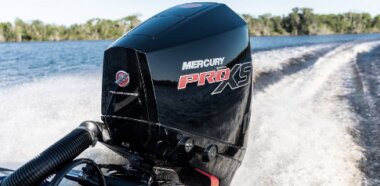
Mercury 135 Black Max Specifications
| Engine Model: Mercury Black Max 135 |
| Engine Type: 2-stroke 6-cylinder gasoline outboard engine |
| Total Displacement: 121.9 cu.in (2 L) |
| Rated Engine Power: 135 Hp (101 kW) at 5500 rpm |
| Fuel System: Two-barrel carburetor |
____________________________________________________________________________________
The Mercury Black Max 135 was a mainstay in
Mercury's outboard lineup, offering 135 Hp from a compact and
lightweight V6 powerhead. It is immediately recognizable by its
clamshell-style cowling, which encloses the engine and contributes to
its classic aesthetic. The engine utilizes loop-charged fuel induction
for efficient combustion and features a single-point, variable ratio oil
injection system, drawing oil from a remote external tank to eliminate
the need for pre-mixing fuel.
Known for its mechanical simplicity and rugged construction, the Black
Max 135 is a favorite among enthusiasts and boaters who value
straightforward, repairable powerplants. Its design prioritizes low-end
torque and reliable operation, making it suitable for powering a wide
range of hulls, from bass boats to smaller cruisers.
Maximum Power Output: 135 Hp (101 kW) at the propeller shaft.
Full Throttle Operating Range: 5000 to 5600 RPM.
Engine Type: 60-degree V6, two-stroke.
Displacement: 121.9 cubic inches (2.0 liters).
Fuel System: Loop-charged induction with carburetion.
Lubrication System: Single-point, variable ratio oil injection drawing
from an external remote oil tank.
Ignition System: Solid state, breakerless distributor or later model
years featured Mercury's Thunderbolt CD ignition.
Alternator Output: 40 A (504 W) for charging batteries and powering
onboard electrical systems.
Starting System: Electric start.
Compatible Fuel: Unleaded regular gasoline with a minimum octane rating
of 87.
The foundation of the Mercury 135 Black Max is a compact and lightweight
60-degree V6 cylinder block designed for strength and efficient power
production.
Configuration: 60-degree V6.
Displacement: 121.9 cubic inches (1998 cc).
Bore and Stroke: 79 mm (3.13 inches) and 67 mm (2.65 inches).
Cylinder Block Material: Precision-cast aluminum alloy with cast-in iron
cylinder liners for durability and wear resistance. Engine Type:
Two-stroke, which utilizes a fuel and oil mixture for internal
lubrication, enabling a simpler design with fewer moving parts than
four-stroke counterparts.
Configuration: Two cylinder heads, one for each bank of three cylinders.
Combustion Chamber: Optimized wedge or domed design within each cylinder
head to promote efficient loop charging of the air-fuel mixture. The
engine utilizes piston-controlled intake and exhaust ports. The
loop-charged design directs the incoming fuel charge in a loop to
scavenge exhaust gases efficiently.
The fuel system on the Mercury Black Max 135 is a carbureted design,
tuned to deliver the air-fuel mixture required for the two-stroke
combustion process.
Induction System: Loop-charged, a design that optimizes the flow of the
fuel charge within the cylinder for more complete combustion and
improved efficiency compared to cross-flow designs.
Fuel Delivery: Three two-barrel carburetors, one for each cylinder pair,
provide the air-fuel mixture. A mechanical fuel pump, often driven by
crankcase pressure pulses, delivers fuel from the boat tank. Recommended
Fuel: Minimum 87-octane unleaded petrol is specified to ensure proper
combustion and prevent pre-ignition.
The lubrication system is a defining feature of this engine, moving
beyond simple pre-mix to offer automated oil delivery for convenience.
System Type: Single-point, variable ratio oil injection. This system
automatically meters two-stroke oil from a remote external tank into the
fuel stream based on engine speed and load.
Oil Tank: A separate, remote-mounted oil tank is installed in the boat,
allowing for bulk oil storage and reduced need for frequent refilling.
Oil Type: Mercury Premium or Quicksilver Premium Plus 2-Cycle Outboard
Oil, TC-W3 certified.
Backup System: In case of oil injection failure, the engine can be
operated by pre-mixing fuel at a 50:1 ratio as a fail-safe measure.
To manage engine temperature under varying loads and conditions, the
Mercury 135 Black Max uses a positive displacement water pump for raw
water cooling.
System Type: Pressure-controlled water cooling, drawing outside water
through an intake in the gearcase to cool the engine block and cylinder
heads.
Core Components: A rubber-impeller water pump, driven by the driveshaft,
pulls water from the lake or ocean. A thermostat in each cylinder head
regulates the flow to maintain the engine at its optimal operating
temperature.
| Mid Section and Lower Unit |
The mid-section houses the exhaust and driveshaft, while the lower unit
transfers power to the propeller. The gearcase is designed to handle the
engine's significant torque output.
Gearcase Design: A heavy-duty, precision-cut gearcase designed for
durability and efficient power transfer. Gear Ratio: 2.00:1. Gear Shift:
Standard forward-neutral-reverse (F-N-R) shifting operation, typically
activated mechanically or with early hydraulic systems.
Exhaust: Through-propeller exhaust release for quieter operation and
reduced back pressure. At idle, exhaust is released through a separate
port above the anti-ventilation plate. Gearcase Lubrication: The
gearcase holds dedicated high-grade marine gear lubricant. Regular
inspection and replacement are part of standard maintenance.
The engine is equipped with an integrated hydraulic system that allows
the operator to adjust the engine's angle relative to the transom for
optimal performance. System Type: Integrated power trim and tilt,
controlled by dashboard-mounted rocker switches.
Trim: Allows the operator to adjust engine angle within a range while
underway to optimize boat attitude, improve fuel efficiency, and enhance
ride quality.
Tilt: Lifts the engine out of the water for trailering, launching,
beaching, or shallow water anchoring.
Shallow Water Capability: The tilt function enables operation in very
shallow water by raising the engine and propeller to avoid striking the
bottom.
Standard Propeller: The engine is typically fitted with an aluminum
three-blade propeller as standard equipment, selected to allow the
engine to operate within its recommended full-throttle RPM range.
Black Max Propeller Series: Mercury produced a dedicated line of Black
Max propellers designed for engines under 250 hp, including the 135.
These propellers are made from Mercalloy, a patented high-strength
aluminum alloy, and feature Flo-Torq hub systems for vibration dampening
and lower unit protection.
Propeller Selection: The correct propeller allows the engine to operate
within its recommended full-throttle RPM range of 5000-5600 when the
boat is normally loaded. Various pitch and diameter options are
available to fine-tune performance for specific applications, with
documented sizes including 9.75" diameter with 9.5" pitch, 14.5"
diameter with 19" pitch, and 10" diameter with 8" pitch, among others.
Shaft Length is available in two primary
configurations:
Long shaft: 508 mm (20 inches), designed for boats with a standard
transom height.
Extra-long shaft: 635 mm (25 inches), for boats with higher transoms.
Dry Weight: The approximate dry weight is 189 kg (417 lbs). This
relatively light weight for a 135 hp V6 contributed to its popularity
for performance-oriented boats.
Routine Maintenance (Every 100 Hours /
Annually):
Inspect and clean or replace spark plugs.
Check and clean the fuel filters and water-separating fuel filter.
Inspect the fuel system for leaks or deterioration.
Replace the gearcase lubricant.
Lubricate all moving parts and pivot points, including the trim/tilt
system.
Check and clean the anti-corrosion anodes, replacing them if they are
more than 50% eroded.
Inspect the water pump condition by checking tell-tale stream; replace
impeller as preventative maintenance every 2-3 years.
Critical Maintenance Items:
Oil Injection System: Regularly verify the oil injection system is
functioning correctly and that there are no air leaks in the oil lines
to prevent engine damage.
Carburetor Synchronization: Periodically check and adjust carburetor
synchronization and idle mixture for smooth operation and optimal
performance.
Linkage and Throttle Cables: Inspect and lubricate throttle and shift
linkages to ensure positive control.
Periodic Checks:
Battery condition and electrolyte levels.
Propeller condition for dings, cracks, or fishing line.
Engine mounting hardware and steering system fasteners for correct
torque.
Compression testing: For a well-maintained engine in good operating
condition, compression readings across all six cylinders are generally
expected to be within 100-120 PSI and within 10-15% of each other.
Cylinder Head Bolts: final torque of 27-33 Nm (20-24 lb-ft).
Spark Plugs: 27 Nm (20 lb-ft).
Propeller Nut: 40 Nm (30 lb-ft).
Gearcase Mounting Nuts: 40 Nm (30 lb-ft).
Engine Mounting Bolts (to transom): 55-60 Nm (41-44 lb-ft).
Bass Boats: Its high power-to-weight ratio and rapid acceleration made
it an excellent choice for fast, lightweight fiberglass bass boats,
providing the speed needed for tournament fishing and covering large
water areas.
Fish and Ski Boats: The engine provided ample power for water sports
like slalom skiing and tubing while maintaining the fuel efficiency
desired for recreational cruising and fishing.
Bay Boats and Center Consoles: The engine's durability and power suited
it for bay boats and smaller center console fishing boats used in
coastal environments.
Small to Medium Runabouts and Cruisers: The 135 hp rating is suitable
for powering 16 to 20-foot fiberglass runabouts and small family
cruisers, offering a balance of speed and cruising capability.
Pontoon Boats: With its torque and reliability, the Black Max 135 was
also used on larger pontoon boats, providing the necessary power to move
these heavier vessels efficiently.
____________________________________________________________________________________
| Outboard Engines Technical Specifications |
| Small Engines Technical Specifications |
| Car Engines Technical Specifications |
| Industrial Engines Technical Specifications |