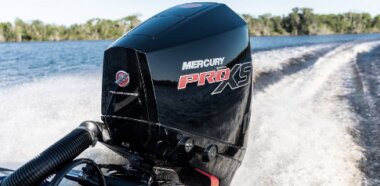
Mercury 115 Optimax Specifications
| Engine Model: Mercury Optimax 115 |
| Engine Type: 2-stroke inline 3-cylinder gasoline outboard engine |
| Total Displacement: 93 cu.in (1.5 L) |
| Rated Engine Power: 115 Hp (84.5 kW) at 5700 rpm |
| Fuel System: Direct Fuel Injection (DFI) |
____________________________________________________________________________________
The Mercury Optimax 115 is a direct fuel
injection two-stroke outboard that earned a reputation for outstanding
performance, fuel economy, and reliability. Its defining feature is the
Orbital Combustion Process fuel system, which injects a highly atomized
mixture of fuel and compressed air directly into the combustion
chambers. This technology virtually eliminates the smoke and rough
idling associated with carbureted two-strokes while delivering
exceptional throttle response and power.
Operators appreciate its light weight compared to four-stroke
alternatives, which contributes to better boat performance and fuel
economy. The engine's robust construction includes components shared
with the larger V6 Optimax models, ensuring durability and parts
availability. While the three-cylinder configuration produces some
vibration at idle speeds, this characteristic diminishes once the engine
is running, and the overall package remains a favorite among boaters
seeking a balance of power, efficiency, and value.
Engine Type: 3-cylinder in-line, 2-stroke
Power: 115 HP (84.5 kW) at the propshaft
Displacement: 93 cubic inches (1526 cc)
Bore and Stroke: 3.63 inches (92 mm) bore by 3.00 inches (76 mm) stroke
Full Throttle RPM Range: 5000-5750 RPM
Fuel System: Two-stage Direct Fuel Injection (DFI)
Induction System: Loop-charged with deflector-shaped pistons
Ignition System: Digital inductive CDI with electronic spark advance
Alternator Output: 60 amp / 756 watt, belt-driven and voltage-regulated
Starting System: Electric (turn-key)
Gear Ratio / Shift: 2.07:1 with forward-neutral-reverse
Lubrication: Variable-rate oil injection with 4.7-liter onboard oil tank
Shaft Length Options: 20-inch (L) or 25-inch (XL)
Cooling System: Water-cooled with thermostat and pressure-controlled
poppet valve
Recommended Fuel: Unleaded gasoline with minimum 87 octane
Recommended Oil: Quicksilver TC-W3 Premium Plus 2-Cycle Outboard Oil or
equivalent
Emissions Rating: Three-star CARB rating
The foundation of the Optimax 115 is its inline three-cylinder
powerhead, a robust casting designed to withstand the demands of direct
injection operation. The cylinders incorporate loop-charging technology
with exclusive deflector-shaped pistons that work in concert with
specially designed combustion chambers. This piston and chamber geometry
directs the fuel-air charge efficiently toward the spark plug, enhancing
combustion efficiency and lowering emissions while improving fuel
economy.
The cylinder head configuration includes two thermostats, one in each
cylinder head, which regulate operating temperature. These thermostats
open at 143°F (61.6°C) to control water flow through the heads at lower
engine speeds. The engine shares piston and component designs with the
larger V6 Optimax models ranging from 200 to 250 Hp, which simplifies
parts availability and speaks to the robust engineering applied to this
powerhead.
The heart of the Optimax 115 is its two-stage Direct Fuel Injection
system, a sophisticated design developed by Australia's Orbital Engine
Corporation. This system represents a fundamental departure from
conventional two-stroke fuel delivery. In the first stage, fuel is mixed
with compressed air supplied by an engine-driven air compressor. This
compressor provides a steady charge of cooled air for maximum combustion
efficiency. The second stage injects this highly atomized mixture
directly into the combustion chambers at precisely controlled intervals.
The result is incredibly complete combustion that eliminates raw fuel
loss through the exhaust, drastically reduces hydrocarbon emissions, and
delivers fuel consumption figures approaching those of four-stroke
engines while maintaining the power-to-weight advantage of two-stroke
design. The system includes a fuel cooler integrated with the cooling
water circuit; an internal leak in this component would force fuel into
the cooling system, creating a detectable condition.
The Optimax 115 employs a variable-rate oil injection system that
eliminates the need for pre-mixing fuel. An onboard 4.7-liter oil tank
supplies oil to the injection pump, which meters lubrication according
to engine speed and load. This system ensures proper lubrication under
all operating conditions while minimizing oil consumption and exhaust
smoke. The oil pump delivers oil directly to the intake air stream,
where it mixes with the fuel-air charge before entering the crankcase.
The system uses Quicksilver TC-W3 Premium Plus 2-Cycle Outboard Oil or
equivalent certified TC-W3 formulations. A low-oil warning system alerts
the operator when the oil level requires replenishment. This precision
oil delivery contributes to the engine's clean operation, with virtually
no visible smoke during normal running.
The cooling system on the Optimax 115 is a sophisticated water-cooled
design with multiple control points to maintain optimal temperatures
across the operating range. At low engine speeds below 1500 RPM, the
twin thermostats regulate water flow based on engine temperature. When
the thermostats open, water passes through the cylinder heads and exits
to the driveshaft housing. At higher RPM above 1500 RPM, a poppet valve
located at the bottom starboard side of the powerhead assumes primary
control of water flow.
Water passing through the poppet valve enters passages in the adaptor
plates before reaching the driveshaft housing, where it builds a wall of
water around the exhaust tube to silence exhaust and prevent air
ingestion into the water pump. The air compressor has its own dedicated
water supply circuit, with a strainer screen protecting this critical
component; a restricted screen will cause the compressor to overheat and
the tell-tale stream to weaken. Water exits the engine through three
pathways: around the gear housing anodes, through the tell-tale after
passing through the air compressor, and through two 1/8-inch (3.175 mm)
holes in the lower adaptor plate.
| Mid Section and Lower Unit |
The mid section houses the driveshaft and provides the structural
connection between powerhead and lower unit while containing the exhaust
passage. The lower unit contains the gearcase with a 2.07:1 gear ratio,
which is slightly taller than the ratios used on the smaller Optimax 75
and 90 models.
This gear ratio provides an excellent balance of acceleration and
cruising efficiency for the 115 Hp output. The gearcase contains a
forward-neutral-reverse shifting mechanism and is protected by
sacrificial anodes that control galvanic corrosion in saltwater
environments. The gear housing features water exit points around these
anodes as part of the cooling system design.
Gear Ratio: 2.07:1
Shift: Forward-Neutral-Reverse
Corrosion Protection: Sacrificial anodes on gear housing
The Optimax 115 incorporates a hydraulic Power Trim system that provides
precise control over engine angle for optimal performance across varying
conditions. The system consists of an electric motor, pressurized fluid
reservoir, pump, tilt cylinder, and two trim cylinders.
Operators can trim the outboard up or down using switches on the remote
control or trim panel, whether the engine is running or not. Trimming
the outboard up lifts the boat bow, increasing top speed and providing
greater gearcase clearance over submerged objects. Trimming down
improves acceleration and helps the boat achieve plane more quickly.
The system incorporates a safety feature that prevents trimming above 20
deg when engine RPM exceeds approximately 2000, though the operator can
trim beyond this angle for shallow water operation by keeping engine
speed below 2000 RPM. A tilt pin adjustment allows owners to limit the
trim-under range on boats with greater-than-normal transom angles,
preventing excessive bow-down operation that could cause handling
issues.
Propeller selection for the Optimax 115 requires matching the propeller
pitch to the boat's weight, hull design, and intended usage to ensure
the engine operates within its 5000-5750 RPM full throttle range.
Mercury's Vengeance propeller series is a common matching choice for
this engine.
For a 6-meter rigid inflatable boat weighing approximately 1000 kg with
typical loads, a 17-inch pitch propeller with 13.5-inch diameter has
proven effective, delivering approximately 35 knots at 5000 RPM with
four divers and equipment aboard. Lighter boats or those seeking higher
top speeds might accommodate 18-inch or 19-inch pitches, though
over-propping must be avoided to prevent engine lugging and potential
damage.
Dry Weight (Long Shaft): 375 lbs (170 kg)
Dry Weight (Extra-Long Shaft): 385 lbs (175 kg)
Shaft Length Options: 20 inches (508 mm) or 25 inches (635 mm)
Normal Service Interval: Every 50 hours of operation or 60 days,
whichever comes first.
Severe Service Interval: Every 25 hours of operation or 30 days,
whichever comes first. Operation in saltwater areas constitutes severe
service and requires more frequent attention.
Annual Service: Mercury recommends servicing every 100 hours or annually
after the initial 20-hour break-in service.
Fuel Filter Replacement: The water-separating fuel filter should be
replaced every 100 hours or once annually.
Cooling System Flushing: After operation in salt or brackish water,
flush the cooling system by removing the plug from the fitting in the
bottom cowl and attaching a water hose, running water for 3 to 5
minutes.
Steering System Inspection: Check steering system components for wear
and verify fastener torque at each maintenance interval.
Corrosion Protection: Regularly inspect sacrificial anodes and replace
when significantly depleted.
The Mercury Optimax 115 powers a diverse range of watercraft, from
fishing boats to family runabouts. Its combination of power, light
weight, and fuel efficiency makes it particularly well-suited for boats
in the 5 to 6.5-meter range. Testing on a Stacer 565 Coral Master Sports
Runabout demonstrated the engine's capability, planing cleanly from
trolling speed in just 2.5 seconds while pushing approximately one tonne
of total weight including two adults. The engine maintains a clean plane
at only 2700 RPM, a capability few four-stroke 115 Hp outboards can
match, and achieves its most economical cruise at 3000 RPM.
On a 6-meter Humber Destroyer RIB weighing 900-1000 kg, the Optimax 115
delivers excellent performance for both cruising and diving
applications. Its proven saltwater corrosion protection and outstanding
warranty coverage make it a logical repower choice for older hulls, and
parts availability remains strong due to component sharing with larger
V6 Optimax models. The engine suits both recreational and commercial
applications where reliability and operating economy are paramount.
____________________________________________________________________________________
| Outboard Engines Technical Specifications |
| Small Engines Technical Specifications |
| Car Engines Technical Specifications |
| Industrial Engines Technical Specifications |