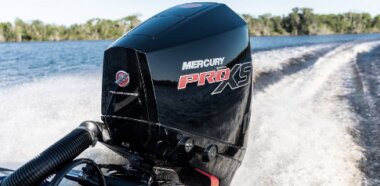
Yamaha 50HETO Specifications
| Engine Model: Yamaha 50HETO |
| Engine Type: 2-stroke inline 3-cylinder gasoline outboard engine |
| Total Displacement: 42.6 cu.in (698 cc) |
| Rated Engine Power: 50 Hp (36.8 kW) at 5000 rpm |
| Fuel System: Carburetor |
____________________________________________________________________________________
The Yamaha 50HETO is a 50-horsepower,
three-cylinder, two-stroke outboard engine designed for boaters seeking
a robust and reliable power source with enhanced convenience features.
This model is distinguished by its electric start system, remote control
steering capability, and the inclusion of an oil injection system and
power trim and tilt.
These features elevate the boating experience, offering effortless
operation and the ability to fine-tune boat attitude for optimal
performance and fuel efficiency. Built upon Yamaha's proven
three-cylinder architecture, the 50HETO delivers a smooth, responsive,
and efficient power output, making it a versatile choice for a wide
array of boat types and applications. The engine's construction utilizes
Yamaha's proprietary YDC-30 marine alloy, providing superior resistance
to the corrosive effects of the marine environment.
The Yamaha 50HETO is a 2-stroke, inline 3-cylinder engine (L-type). The
total displacement is 698 cc (42.6 cu.in), achieved through a bore and
stroke of 67.0 mm (2.64 inches) and 66.0 mm (2.60 inches), respectively.
It produces a maximum prop shaft output of 36.8 kW, equivalent to 50
horsepower, at 5,000 rpm. The engine has a full throttle operating range
of 4,500 to 5,500 rpm. The compression ratio is stated as 6.0:1. The
engine family and its certified emission levels are detailed on a label
affixed to the engine's bottom cowling.
The engine utilizes a loop charge scavenging system, which creates a
circular flow of the fuel-air charge for efficient transfer of exhaust
gases and even distribution of the mixture, resulting in greater
combustion efficiency and improved fuel economy.
The intake system employs reed valves. The powerhead is designed for
longevity and dependable operation in various conditions, featuring a
superior exhaust manifold design and ideal crankshaft arrangement to
deliver excellent response throughout low and mid-range RPM.
The cylinder head bolts and engine mounting bolts require periodic
retightening to specification as part of routine maintenance. The
starting serial number block for this model is S: 210142 and L: 444058
for worldwide models.
The fuel system is based on three individual carburetors, one for each
cylinder. The carburetors require periodic inspection of fuel and air
passages for fouling or clogging, which should be cleaned with suitable
solvent and compressed air. The enrichment system utilizes Yamaha's
Prime Start feature for effortless starting.
The engine operates on regular unleaded gasoline with a minimum octane
rating of 86 (R.O.N.). The remote fuel tank has a capacity of 24 liters.
A thorough inspection of the entire fuel system, including lines and
tanks, for leaks, cracks, or malfunction is a critical safety procedure.
The lubrication system is a Precision Blend multi-point oil injection
system, which injects a precise amount of oil needed by the motor
directly into the intake manifold during operation. This system
eliminates the need for pre-mixing fuel and oil, ensuring quick response
to the engine's oil demands for reliability while minimizing smoke and
oil consumption.
The specified engine oil is a 2-stroke outboard motor oil that meets
NMMA-certified TC-W3 grade standards, such as YAMALUBE. The engine oil
tank has a capacity of 1.5 liters (1.6 US quarts). The system includes
an oil level warning system that should be tested periodically.
Cooling is managed by a raw-water system that circulates water through
the engine. The system's water pump impeller must be submerged in water
whenever the engine is operating to prevent overheating and subsequent
damage.
Before running the engine, a visual check must be made to ensure the
cooling water ports are not clogged with foreign matter. The thermostat
and related components require periodic inspection and maintenance as
outlined in the service schedule.
| Mid Section and Lower Unit |
The exhaust system is designed to expel gases through the propeller
boss, contributing to quieter operation and reduced underwater noise.
The gear shift positions are forward, neutral, and reverse. The gear
ratio is 1.85 (derived from a 24/13 gear set). The reduction gear type
is spiral bevel gear, and the clutch is a dog type. The propeller shaft
utilizes a spline drive, and the propeller rotation, when viewed from
the rear, is clockwise.
The gear case requires hypoid gear oil meeting API GL-4 SAE 90
standards, with a total capacity of 0.43 liters (0.45 US quarts). When
draining the gear oil, it should be inspected for water or metallic
sediment, as a "milky" appearance indicates water entry requiring seal
replacement.
The engine is equipped with a power trim and tilt system, allowing for
convenient engine operation and adjustments to the boat's attitude to
meet changing conditions while underway. The trim angle is adjustable
within a range of -4 to 20 degrees. The tilt-up angle is 69 degrees.
The system also features a shallow water drive capability, allowing the
engine to be quickly set and operated at a tilted angle for safe
navigation through shallow water. The steering angle is 40 degrees in
both directions. Regular inspection of the power trim and tilt system
for proper operation and fluid leaks is part of the maintenance
schedule.
A wide range of aluminum propellers is available for the Yamaha 50HETO
to accommodate various boat types, loading conditions, and performance
requirements. All propellers have three blades and utilize a spline
drive system. Available sizes, listed by diameter and pitch in inches,
include: 10 x 15, 10-1/4 x 14, 10-3/4 x 16, 10-3/4 x 17, 10-3/8 x 13,
10-5/8 x 12, 11-1/8 x 13, 11-1/4 x 14, 11-3/8 x 12, 11-5/8 x 11, 11-3/4
x 10, 12-1/4 x 9, 12 x 11, and 12 x 12.
Selecting the correct propeller is essential for achieving optimal
engine performance within the recommended full throttle operating range.
The propeller is marked with its specifications, for example,
"3x11-1/4x12" indicates three blades, 11-1/4 inches diameter, and 12
inches pitch.
The overall length of the outboard is 670 mm (26.4 inches), and its
overall width is 360 mm (14.2 inches). Three shaft length options are
available. The overall height for the short shaft model is 1,192 mm
(46.9 inches), designed for a transom height of 381 mm (15.0 inches).
The long shaft model has an overall height of 1,319 mm (51.9 inches) for
a transom height of 508 mm (20.0 inches).
The extra long shaft model has an overall height of 1,433 mm (56.4
inches) for a transom height of 635 mm (25.0 inches). The dry weight for
the short shaft version is 85.5 kg (189 lbs). The long shaft version
weighs 88 kg (194 lbs), and the extra long shaft version weighs 91.5 kg
(201.7 lbs).
Routine maintenance is essential for optimal performance and longevity.
The engine is equipped with a maintenance-free CDI (Capacitor Discharge
Ignition) ignition system with electric automatic advance, which
provides a strong spark and precise timing, preventing plug fouling and
improving starting performance. The alternator output is 6A with a
rectifier/regulator to charge a 12V battery.
A 12V 70AH battery with a minimum cold crank performance of 380 A at
-17.8°C (0°F) is recommended. The standard spark plug for the 50HETO is
an NGK B8HS-10 or BR8HS-10. The spark plug gap should be maintained
between 0.9 and 1.0 mm (0.035 to 0.039 inches). When installing spark
plugs, the threads should be clean, and the plug should be torqued to
specification. If a torque wrench is not immediately available, the plug
can be initially tightened 1/4 to 1/2 turn past finger-tight, with final
torquing performed as soon as possible.
The maintenance schedule includes key services at initial 10 hours
(break-in), 50 hours (3 months), 100 hours (6 months), and 200 hours (1
year) intervals. Items requiring periodic attention include the anode,
battery, carburetor linkage, cylinder head bolts, engine mounting bolts,
flywheel nut, fuel filter, fuel tank and lines, gear oil, idle speed,
ignition timing, oil injection pump and linkage, oil level warning
system, power trim and tilt system, propeller, and spark plugs.
Idle speed should be checked and adjusted to 800 ± 50 rpm with the motor
in the water or a test tank, using a tachometer for accurate
measurement. The ignition timing requires specific adjustment procedures
and tools, including verifying the timing plate position and checking
full-advance and full-retard settings.
Adhering to correct torque specifications is critical during assembly
and maintenance to ensure proper sealing, component retention, and safe
operation. Critical fasteners require precise torquing, often in
specific sequences or stages. The cylinder head bolts are tightened in a
two-step process: first to 15 Nm (11 lb-ft), and finally to 28 Nm (20
lb-ft). The engine unit bolt requires 21 Nm (15 lb-ft).
The flywheel nut is a critical fastener torqued to 110 Nm (80 lb-ft).
The reed valve bolt is set to a light 1 Nm (0.7 lb-ft). The spark plug
is torqued to 25 Nm (18 lb-ft). The propeller nut is set at 30 Nm (22
lb-ft). The lower unit bolt requires 40 Nm (29 lb-ft). The propeller
shaft housing bolt is torqued to 16 Nm (11 lb-ft).
Tiller handle components, though not standard on the 50HETO, have
specific torques for related models: the mounting nut is 38 Nm (27
lb-ft), the steering friction mounting nut is 20 Nm (14 lb-ft), and the
tiller handle pivot bolt is 38 Nm (27 lb-ft). Both the muffler bolt and
exhaust manifold bolt are torqued to 21 Nm (15 lb-ft), and the exhaust
guide bolt also requires 21 Nm (15 lb-ft).
The Yamaha 50HETO is intended for use on boats where the total
horsepower does not exceed the vessel's maximum rated power capacity, as
indicated on the boat's capacity plate. Its 50-horsepower output,
electric start, remote steering, and power trim/tilt make it suitable
for a wide range of medium-sized craft, including aluminum fishing
boats, utility skiffs, pontoon boats, and small center-console vessels.
The multiple shaft length options allow for proper fitment on boats with
15-inch, 20-inch, or 25-inch transoms. Proper installation and adherence
to the boat's maximum horsepower rating are essential to ensure safe
handling and prevent loss of control. As with all outboards, operators
must always ensure the engine stop switch lanyard is attached to a
secure part of their clothing or life jacket.
____________________________________________________________________________________
| Outboard Engines Technical Specifications |
| Small Engines Technical Specifications |
| Car Engines Technical Specifications |
| Industrial Engines Technical Specifications |