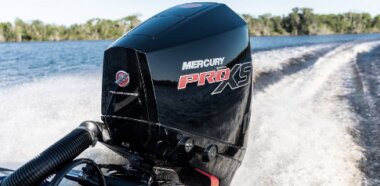
Yamaha F50FET Specifications
| Engine Model: Yamaha F50FET |
| Engine Type: 4-stroke inline 4-cylinder SOHC 8-valve gasoline outboard engine |
| Total Displacement: 60.8 cu.in (996 cc) |
| Rated Engine Power: 50 Hp (36.8 kW) at 5500 rpm |
| Fuel System: Electronic Fuel Injection (EFI) |
____________________________________________________________________________________
The Yamaha F50FET is a 50-horsepower,
four-stroke, inline four-cylinder outboard motor that represents a
significant advancement in outboard technology with its electronic fuel
injection system. This engine is designed for boaters who demand the
ultimate in smoothness, fuel efficiency, and precise power delivery for
a wide variety of vessels.
At its core is a 996 cc powerhead featuring a single overhead camshaft
(SOHC) and eight valves, delivering refined, responsive power across the
entire rpm range. The F50FET utilizes a sophisticated TCI ignition
system and Yamaha's advanced EFI (Electronic Fuel Injection), which
ensures clean, efficient performance, effortless starting in all
conditions, and optimal fuel metering.
A standout feature is the variable trolling RPM switch, which allows for
precise speed control, making it ideal for slow-speed maneuvering and
trolling applications. This model, designated F50FET, features electric
start, power trim and tilt, and is designed for remote control
operation, making it a versatile and technologically advanced choice for
fishing boats, pontoons, and small cruisers. The engine is also
compatible with the optional YCOP immobiliser system for enhanced
security.
Engine type: 4-Stroke, SOHC, In-line 4, 8-Valve
Number of cylinders: 4
Total displacement: 996 cc (60.8 cu in)
Bore and stroke: 65.0 x 75.0 mm (2.56 x 2.95 in)
Power output: 36.8 kW (50 hp) at 5,500 rpm
Full throttle operating range: 5,000-6,000 rpm
Idle speed: 700-800 rpm
Compression ratio: 9.5:1
Fuel system: EFI (Electronic Fuel Injection)
Ignition system: TCI (Transistor Controlled Ignition)
Starting system: Electric
Control system: Remote control
Alternator output: 12V - 16A with rectifier/regulator
Spark plug: NGK DPR6EB-9
Spark plug gap: 0.8-0.9 mm (0.031-0.035 in)
Cooling system: Water, thermostatically controlled
Exhaust system: Through propeller hub
Lubrication system: Wet sump
Recommended fuel: Regular unleaded gasoline (minimum 86 octane)
Fuel tank capacity: 25.0 L (6.6 US gal)
Engine oil grade: 4-stroke outboard motor oil (Yamalube recommended)
Engine oil type: SAE 10W-30 or 10W-40, API SE, SF, SG, SH, SJ, SL
Engine oil capacity: 2.5 L (2.6 US qt)
Gear oil type: Hypoid gear oil SAE90
Gear oil capacity: 0.43 L (0.45 US qt)
Gear ratio: 1.85 (24/13)
Gear shift positions: Forward - Neutral - Reverse
Reduction gear type: Spiral bevel gear
Clutch type: Dog clutch
Propeller shaft type: Spline
Propeller direction (rear view): Clockwise
Trim and tilt system: Power Trim and Tilt
Shallow water drive: Included
Steering angle: 40 degrees each direction
The Yamaha F50FET is constructed around a precision-engineered 996 cc
inline four-cylinder powerhead. The cylinder block is made from
high-strength aluminum alloy, providing a lightweight yet rigid
foundation for the internal components. The cylinder bore and stroke are
configured at 65.0 mm and 75.0 mm respectively.
The cylinder head features a single overhead camshaft (SOHC) operating
eight valves via rocker arms, with two intake and two exhaust valves per
cylinder. The powerhead assembly is designed for smooth operation and
long service life.
The closed-deck cylinder block design ensures structural integrity,
while the pistons are made from high-strength aluminum alloy with
refined skirt designs to reduce friction and noise. The connecting rods
are forged for strength to handle the power output of this engine. The
powerhead is mounted to the mid section using power unit bolts that
require precise torquing.
The SOHC valve train in the F50FET requires periodic valve clearance
inspection and adjustment to maintain optimal performance and quiet
operation. The intake valve clearance, measured with the engine cold, is
specified at 0.15-0.25 mm (0.006-0.010 in).
The exhaust valve clearance, which operates under higher thermal loads,
is set to 0.25-0.35 mm (0.010-0.014 in). The camshaft is driven by a
timing chain, designed for durability and minimal maintenance. The valve
train components are lubricated by pressurized oil from the wet sump
system. The cylinder head incorporates a precision-machined sealing
surface and requires a new gasket upon any reassembly.
The F50FET employs a sophisticated Electronic Fuel Injection (EFI)
system that represents a significant upgrade over carbureted models.
This system precisely meters fuel to each cylinder through fuel
injectors, optimizing the air-fuel mixture for all operating conditions.
The EFI system includes an Electric Control Module (ECM) that processes
data from multiple sensors to calculate the exact fuel requirement,
ensuring clean combustion, improved throttle response, and superior fuel
efficiency. Cold starts are simplified with automatic enrichment,
eliminating the need for a manual choke.
The fuel system includes a high-pressure electric fuel pump, a vapor
separator to manage fuel vapors, and a fuel filter that requires
periodic inspection and replacement. The engine operates on regular
unleaded gasoline with a minimum octane rating of 86. A 25-liter
portable fuel tank is included with the engine.
The Yamaha F50FET utilizes a wet sump lubrication system, where engine
oil is stored in an integrated oil pan at the base of the engine. A
trochoidal oil pump, driven by the crankshaft, circulates oil under
pressure throughout the engine, delivering lubricant to the crankshaft
main bearings, connecting rod bearings, camshaft journals, and valve
train components.
The system includes a full-flow oil filter that removes contaminants
from the oil. An oil pressure sensor monitors system pressure and
triggers a warning if pressure drops below a safe level.
The recommended oil is a high-quality 4-stroke motor oil meeting API SE,
SF, SG, SH, SJ, or SL specifications, with SAE 10W-30 or 10W-40 being
suitable for most operating conditions. The engine oil capacity is 2.5
liters (2.6 US quarts) without filter replacement. The oil drain plug is
torqued to 27 Nm (20 lb-ft), and the oil filter to 18 Nm (13.5 lb-ft).
Regular oil and filter changes are essential for engine longevity.
The cooling system is a raw-water, thermostatically controlled design. A
high-capacity water pump, driven by the driveshaft, draws water from the
body of water through an inlet in the lower unit. This water is then
circulated through water jackets in the cylinder block and cylinder head
to absorb combustion heat.
The system is regulated by a thermostat that maintains optimal operating
temperature by controlling water flow. The F50FET features a freshwater
flushing device, allowing owners to easily connect a garden hose to
flush the cooling system with fresh water after operation in salt or
polluted water, significantly reducing corrosion risk.
The cooling system includes a cooling water temperature sensor that
monitors engine temperature and communicates with the ECM to optimize
engine operation and trigger overheat protection if necessary. An
overheat warning device activates if the engine exceeds safe operating
temperatures, with an automatic rpm reduction feature to protect the
engine.
| Mid Section and Lower Unit |
0The mid section houses the driveshaft and exhaust passage, connecting
the powerhead to the lower unit. The lower unit contains the reduction
gearing and propulsion components. The gear ratio is 1.85:1, achieved
with a pinion gear and forward gear set of 24/13 teeth.
The reduction gears are of the spiral bevel type, selected for their
strength and smooth, quiet operation. The clutch mechanism is a dog
clutch, providing positive engagement for shifting. Gear shift positions
are forward, neutral, and reverse. The propeller shaft is splined to
accept a wide range of propeller options. The lower unit housing is
constructed from corrosion-resistant materials and incorporates
sacrificial anodes to protect against galvanic corrosion.
The gear housing is filled with hypoid gear oil meeting SAE 90
specifications, with a total capacity of 0.43 liters (0.45 US quarts).
The lower unit bolts (M10) require a torque of 40 Nm (29 lb-ft). Regular
inspection and periodic changing of the gear oil are necessary to detect
water ingress or wear particles.
The Yamaha F50FET is equipped with a power trim and tilt system,
allowing effortless adjustment of the engine angle relative to the boat
transom. The system uses an electro-hydraulic pump and dual hydraulic
cylinders to raise and lower the engine. The trim angle range extends
from -4 degrees (trimmed fully in, forcing the bow down for planing) to
+20 degrees (trimmed out for optimal running attitude).
The system also provides a tilt-up angle of 69 degrees for beaching,
launching, trailering, or shallow water operation. A shallow water drive
feature is included, allowing the engine to be tilted up partially for
navigating in very shallow water while still providing propulsion. The
power trim and tilt system is controlled by rocker switches on the
remote control. The system includes a trim rod that should be retracted
during mooring to protect it from marine growth and corrosion.
Selecting the correct propeller is essential for optimizing the
performance of the Yamaha F50FET. The engine is designed to operate
within its full throttle rpm range of 5,000-6,000 rpm, and the propeller
pitch must be chosen so that, with a normal boat load, the engine
reaches the upper half of this range at full throttle.
Yamaha offers a comprehensive range of genuine propellers for the
F50FET, designated with the "G" propeller mark. Available propeller
sizes include various diameters and pitches to suit different boat types
and applications. Aluminum propeller options range from 10 x 15 to
11-1/4 x 14 configurations.
Stainless steel propeller options provide enhanced durability and
performance, with sizes ranging from 10-1/4 x 14 to 12 x 11. The
propeller selection guide in the service manual assists in choosing the
appropriate pitch based on boat type, weight, and intended use. The
propeller nut must be tightened to the specified torque of 34 Nm (25
lb-ft).
Overall length: 706 mm (27.8 in)
Overall width: 384 mm (15.1 in)
Overall height (long shaft): 1,415 mm (55.7 in)
Transom height (long shaft): 527 mm (20.7 in)
Weight (long shaft): 110 kg (243 lb)
After first 10 hours or 1 month: Change engine oil and oil filter.
Inspect gear oil for water contamination. Check and retighten all bolts
and nuts. Every 50 hours or 3 months: Inspect and clean spark plugs.
Check and clean fuel filter. Inspect fuel lines and connections for
cracks or damage. Check gear oil level and condition. Lubricate all
control linkages and moving parts.
Every 100 hours or 6 months: Change engine oil and oil filter. Replace
spark plugs. Inspect and clean cooling water passages. Check condition
of sacrificial anodes, replacing if significantly eroded. Check valve
clearance and adjust as necessary.
Every 200 hours or 1 year: Replace water pump impeller. Inspect and
clean entire fuel system, including fuel injectors and vapor separator.
Replace fuel lines if hardened or cracked. Perform a thorough check of
all electrical connections and controls. Change gear oil.
Spark plug: 17 Nm (12.5 lb-ft)
Propeller nut: 34 Nm (25 lb-ft)
Oil drain plug: 27 Nm (20 lb-ft)
Oil filter: 18 Nm (13.5 lb-ft)
The Yamaha F50FET is a versatile and technologically advanced power
choice for a wide range of boat types. Its 50-horsepower output,
combined with its refined four-stroke design and electronic fuel
injection, makes it an ideal engine for aluminum fishing boats,
including jon boats, tiller models, and center consoles where precise
throttle control and fuel efficiency are valued.
Pontoon boats and small deck boats benefit from the engine's smooth
power delivery and quiet operation for leisurely cruising. The variable
trolling RPM feature makes the F50FET particularly well-suited for bass
boats and walleye rigs where precise trolling speed control is essential
for fishing success. The F50FET is also an excellent choice for small to
medium rigid-hull inflatable boats (RIBs) used for recreational boating,
diving, and watersports.
Skiffs, bay boats, and light utility craft in commercial applications
such as aquaculture or marina support also rely on this engine's
durability, fuel efficiency, and advanced features. The compatibility
with the optional YCOP immobiliser system adds an extra layer of
security for boat owners who trailer their vessels or moor in public
areas.
____________________________________________________________________________________
| Outboard Engines Technical Specifications |
| Small Engines Technical Specifications |
| Car Engines Technical Specifications |
| Industrial Engines Technical Specifications |