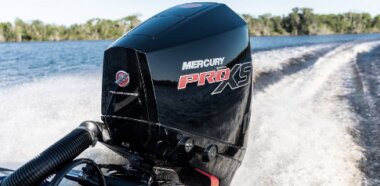
Yamaha E25BMH Specifications
| Engine Model: Yamaha E25BMH |
| Engine Type: 2-stroke 2-cylinder gasoline outboard engine |
| Total Displacement: 30.2 cu.in (496 cc) |
| Rated Engine Power: 25 Hp (18.4 kW) at 5500 rpm |
| Fuel System: Carburetor |
____________________________________________________________________________________
The Yamaha E25BMH is a 25-horsepower,
two-cylinder, two-stroke outboard engine from the manufacturer's
renowned Enduro series, designed to deliver reliable and robust
performance for a variety of small to medium watercraft. This model is
engineered for users who prioritize durability and simplicity, featuring
a manual start system and tiller control for straightforward operation.
It is a lightweight and portable power unit, well-suited for
applications where ease of transport and deployment are essential. The
engine's core design emphasizes longevity, incorporating features such
as a specially hardened crankshaft and long-life piston rings to
withstand demanding marine environments. Its loop-charged scavenging
system and through-propeller exhaust contribute to efficient power
delivery and operation.
The Yamaha E25BMH is a 2-stroke, L-type (inline) engine with two
cylinders. The total displacement is 496 cc (30.27 cu.in), achieved
through a bore and stroke of 72.0 mm (2.83 inches) and 61.0 mm (2.40
inches), respectively. It produces a maximum prop shaft output of 18.4
kW, equivalent to 25 horsepower, at 5,000 rpm. The engine has a full
throttle operating range of 4,500 to 5,500 rpm, and the idle speed is
set between 1,050 and 1,150 rpm. The compression ratio is stated as
6.2:1.
The cylinder head has a specified warpage limit of 0.1 mm (0.0039
inches). The cylinder bore inside diameter is manufactured to measure
between 72.000 and 72.020 mm (2.8346 to 2.8354 inches). The piston
diameter is 71.935 to 71.960 mm (2.8321 to 2.8331 inches), measured at a
point 10.0 mm (0.39 inches) from the piston skirt bottom. The piston pin
outside diameter is 19.895 to 19.900 mm (0.7833 to 0.7835 inches).
The connecting rod specifications include a small-end inside diameter of
23.904 to 23.917 mm (0.9411 to 0.9416 inches) and a big-end inside
diameter of 32.000 to 32.016 mm (1.2598 to 1.2605 inches). The
connecting rod big-end side clearance is set between 0.200 and 0.700 mm
(0.0079 and 0.0276 inches).
The crankshaft is constructed from a specially hardened material to
ensure extended engine life and is precisely balanced to minimize
vibration. The engine utilizes reed valves for intake and a loop charge
scavenging system to optimize the fuel-air mixture delivery and exhaust
removal.
The top piston ring has an end gap specification of 0.20 to 0.35 mm
(0.0079 to 0.0138 inches) and a side clearance of 0.02 to 0.06 mm
(0.0008 to 0.0024 inches). The second ring features an end gap of 0.20
to 0.35 mm (0.0079 to 0.0138 inches) and a side clearance of 0.03 to
0.07 mm (0.0012 to 0.0028 inches). The piston rings are designed for
minimal friction resistance and effective heat conductivity to promote
engine longevity and efficiency.
The fuel system is based on a single carburetor. Starting enrichment is
controlled by a manual choke valve. The engine operates on regular
unleaded gasoline and requires a 50:1 pre-mix ratio with the appropriate
two-stroke oil.
The lubrication system is a pre-mix type, where the engine oil is mixed
directly with the fuel. The recommended engine oil is a 2-stroke
outboard motor oil that meets NMMA-certified TC-W3 grade standards.
Cooling is managed by a raw-water, thermostatically controlled system.
It features a large-capacity, hard-chrome-plated water pump that ensures
a sufficient supply of cooling water under all operating conditions and
resists wear, even in muddy water.
| Mid Section and Lower Unit |
The exhaust system is designed to expel gases through the propeller boss
for quieter and more efficient operation. The gear shift positions are
forward, neutral, and reverse. The gear ratio is 2.08 (derived from a
27/13 gear set). The reduction gear type is spiral bevel gear, and the
clutch is a dog type.
The propeller shaft utilizes a spline drive, and the propeller rotation,
when viewed from the rear, is clockwise. The gear case requires hypoid
gear oil meeting API GL-4 SAE 90 standards, with a total capacity of
0.32 liters (0.34 US quarts).
The engine is equipped with a manual trim system offering five
positions, corresponding to trim angles of 4.0, 8.0, 12.0, 16.0, and
20.0 degrees. The tilt-up angle is 76.0 degrees, enabling shallow water
drive operation to prevent the propeller from striking the bottom when
navigating in shallow water. The steering angle is 40.0 degrees in both
directions.
A range of propeller sizes is available for the Yamaha E25BMH to
accommodate various boat and loading conditions. The propeller size
options all feature a 9-7/8 inch diameter and include the following
pitches: 8, 9, 10, 10-1/2, 11-1/4, 12, 13, and 14 inches.
The overall length of the outboard is 843 mm (33.2 inches), and its
overall width is 399 mm (15.7 inches). Two shaft length options are
available. The overall height for the short shaft model is 1,146 mm
(45.1 inches), with a corresponding transom height of 381 mm (15.0
inches).
The long shaft model has an overall height of 1,273 mm (50.1 inches) and
is designed for a transom height of 508 mm (20.0 inches). The dry weight
for the short shaft version is 53.0 kg (117 lbs), while the long shaft
version weighs 54.5 kg (120 lbs).
Routine maintenance is essential for optimal performance. The engine is
equipped with a CDI (Capacitor Discharge Ignition) system and features
an alternator output of 12V and 80W. The standard spark plug for the
E25BMH model is an NGK BR7HS-10. The spark plug gap should be maintained
between 0.9 and 1.0 mm (0.035 to 0.039 inches).
Periodic inspection and cleaning of the fuel filter are recommended to
ensure no water or foreign matter has accumulated. The engine is fitted
with a warning system that activates in case of overheating,
automatically reducing engine speed to around 2,000 rpm to alert the
operator.
Adhering to correct torque specifications is critical during assembly
and maintenance. The starter nut requires 10 Nm (7.2 lb-ft). The drive
plate bolt is torqued to 15 Nm (11.1 lb-ft), while the starter mount
bolt is 12 Nm (8.9 lb-ft). The power unit mount bolt should be tightened
to 22 Nm (16.2 lb-ft). A critical fastener, the flywheel magnet nut,
requires 140 Nm (103 lb-ft).
The reed valve stopper nut is torqued to 4.5 Nm (3.3 lb-ft). Cylinder
head bolts are tightened in a two-step process: first to 15 Nm (11.1
lb-ft), and finally to 27 Nm (19.9 lb-ft). Crankcase bolts follow the
same procedure: first 15 Nm (11.1 lb-ft), then 27 Nm (19.9 lb-ft). The
spark plug is torqued to 25 Nm (18 lb-ft).
The lower case mount bolt (nut) is set at 37 Nm (27.3 lb-ft). The
cooling water inlet cover screw requires only 4 Nm (3.0 lb-ft). The
propeller nut is torqued to 35 Nm (25.3 lb-ft). The propeller housing
bolt and steering bracket bolt are both set to 11 Nm (8.1 lb-ft). For
the carburetor, the float pin screw and float chamber screw are each
torqued to a light 2 Nm (1.5 lb-ft).
The Yamaha E25BMH is intended for use on boats where the total
horsepower does not exceed the vessel's maximum rated power capacity, as
indicated on the boat's capacity plate. Its 25-horsepower output makes
it suitable for a wide range of small craft, including jon boats,
aluminum fishing boats, dinghies, and small inflatables.
The tiller control and lightweight design make it a versatile choice for
various fishing and leisure activities. Installation must be performed
correctly to ensure safe handling and to prevent loss of control.
____________________________________________________________________________________
| Outboard Engines Technical Specifications |
| Small Engines Technical Specifications |
| Car Engines Technical Specifications |
| Industrial Engines Technical Specifications |