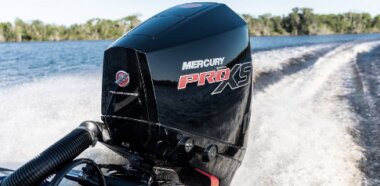
Mercury 75 ELPT Specifications
| Engine Model: Mercury 75 ELPT |
| Engine Type: 4-stroke inline 4-cylinder gasoline outboard engine |
| Total Displacement: 126 cu.in (2.1 L) |
| Rated Engine Power: 75 Hp (56 kW) at 5500 rpm |
| Fuel System: Electronic fuel injection (EFI) |
____________________________________________________________________________________
The Mercury 75 ELPT stands as a benchmark in
the 75 hp outboard category, celebrated for its exceptionally smooth and
quiet operation, immediate throttle response, and class-leading fuel
economy. Its 2.1-liter, 4-cylinder foundation inherently provides
turbine-like smoothness, virtually eliminating the vibration associated
with fewer-cylinder engines. The advanced Electronic Fuel Injection
(EFI) system ensures effortless turn-key starting in all conditions and
optimizes the air-fuel mixture for clean combustion and efficiency
across the entire power band.
Integrated with the SmartCraft digital technology suite, the engine
features the Engine Guardian protection system, which continuously
monitors critical sensors and can automatically reduce power to prevent
damage. The inclusion of a power trim and tilt system adds significant
operational convenience, allowing the operator to optimize boat attitude
for better performance and fuel savings, as well as tilting the engine
for shallow water navigation or trailering.
The Mercury 75ELPT is engineered with precise specifications to deliver
its rated performance and integrate with modern boat systems. Full
Throttle Operating Range: The engine develops its maximum power between
5000 and 5500 RPM.
Maximum Power Output: 75 Hp (56 kW) at the propeller shaft. Fuel System:
Computer-controlled Sequential Multi-Port Electronic Fuel Injection
(EFI) ensures precise fuel metering for every cylinder.
Ignition System: SmartCraft ECM 70 Digital Inductive system, providing
precise spark timing control for optimal performance and efficiency.
Alternator Output: A high-output 35-amp (441-watt) system with a
water-cooled voltage regulator provides ample power for battery charging
and operating sophisticated electronic accessories, even at low engine
speeds.
Compatible Fuel: Unleaded regular gasoline with a minimum octane rating
of 87 (R+M/2) or 90 RON. The fuel may contain up to 10% ethanol. Engine
Management: Fully compatible with SmartCraft digital technology,
including DTS (Digital Throttle & Shift) options and the Engine Guardian
protection system.
The foundation of the Mercury 75 ELPT is a robust, precision-engineered
cylinder block designed for longevity, smooth power delivery, and high
displacement efficiency.
Configuration: Inline 4-cylinder.
Displacement: 2.1 liters (2100 cc / 126 cubic inches).
Bore and Stroke: The cylinder bore is 90 mm (3.5 in) and the piston
stroke is 81 mm (3.2 in).
Engine Type: Four-stroke, which utilizes a separate, internal oil sump
for clean operation and eliminates the need for pre-mixing fuel and oil.
The cylinder head assembly is designed for efficient gas exchange,
contributing to the engine's broad power band and overall efficiency.
Valvetrain Design: 8-valve Single Overhead Camshaft (SOHC)
configuration. Valves per Cylinder: Two, resulting in a total of eight
valves for the engine.
Fuel Induction: The valvetrain supports the advanced Sequential
Multi-Port Electronic Fuel Injection (EFI) system, ensuring an optimal
air-fuel mixture is delivered directly to each intake port.
The fuel system is a central feature of the Mercury 75ELPT, moving
beyond traditional systems to provide enhanced reliability, performance,
and efficiency. Induction System: Computer-controlled Sequential
Multi-Port Electronic Fuel Injection (EFI) replaces the carburetor,
offering precise fuel metering for effortless starting, immediate
throttle response, and superior fuel efficiency across the entire RPM
range.
Fuel Delivery: An electric fuel pump, controlled by the ECM, delivers
fuel from the tank to the injectors at the required pressure.
Recommended Fuel: Minimum 87-octane unleaded petrol is specified to
ensure proper combustion and prevent engine knocking.
The four-stroke design incorporates a self-contained, high-pressure
wet-sump lubrication system that ensures all moving parts are properly
oiled for durability. System Type: Wet sump, where engine oil is stored
in a sump within the oil pan.
Oil Capacity: The engine holds approximately 5.2 liters (5.5 quarts) of
engine oil. Recommended Oil: Mercury FourStroke 25W-40 Marine Oil is the
specified lubricant for optimal protection and performance in marine
environments.
To manage engine temperature under varying loads and conditions, the
Mercury 75 ELPT uses a positive displacement water pump for raw water
cooling. System Type: Pressure-controlled water cooling, drawing outside
water through an intake to cool the engine.
Core Components: A rubber-impeller water pump, driven by the driveshaft,
pulls water from the lake or ocean. A thermostat regulates the flow to
maintain the engine at its optimal operating temperature for efficiency
and longevity.
| Mid Section and Lower Unit |
The mid-section houses the exhaust and driveshaft, while the lower unit
transfers power to the propeller. The gearcase configuration is a key
performance component.
Gearcase Options: Available with a standard gearcase or, in some models
like the SeaPro variant, a heavy-duty Command Thrust (CT) gearcase
designed for higher thrust applications.
Gear Ratio: The standard gear ratio is 2.07:1. Some heavy-duty or SeaPro
models utilize a different gear ratio of 2.38:1 to optimize thrust for
heavier workloads.
Gear Shift: Standard forward-neutral-reverse (F-N-R) shifting operation.
Exhaust: Through-propeller exhaust release for quieter operation and
reduced back pressure.
The engine is equipped with an integrated hydraulic system that allows
the operator to adjust the engine's angle relative to the transom.
System Type: Integrated power trim and tilt, controlled by
dashboard-mounted rocker switches.
Trim: Adjusts engine angle within a range of -6 deg to +16 deg (a total
trim range of 22 deg) while underway to optimize boat attitude, improve
fuel efficiency, and enhance ride quality.
Tilt: Lifts the engine completely out of the water to a maximum of 64
deg from its down position (a total tilt range of 70 deg) for
trailering, launching, beaching, or shallow water anchoring.
Shallow Water Capability: The system provides a shallow water trim range
of up to 20 deg, allowing the engine to be tilted up for operation in
very shallow water without striking the bottom.
Propeller selection is critical for matching engine performance to the
specific boat and its intended use. The Mercury 75 ELPT is compatible
with a range of propellers to fine-tune performance.
Standard Propeller: The engine is typically supplied with a propeller
suited for general application, often an aluminum or stainless steel
design selected to allow the engine to operate within its recommended
full-throttle RPM range.
Propeller Selection: The correct propeller allows the engine to operate
within its recommended full-throttle RPM range of 5000-5500 when the
boat is normally loaded. Various pitch and material options are
available from Mercury to suit specific boating activities.
Shaft Length: Long shaft (L) model with a shaft length of 508 mm (20
inches), designed for boats with a standard transom height.
Dry Weight: The weight varies slightly by model and configuration. The
lightest models have a dry weight of 163 kg (359 lbs). Other
configurations, such as the SeaPro model, have a dry weight of 165 kg
(360-364 lbs).
First 20 Hours / 3 Months:
Inspect and lubricate all moving parts and pivot points.
Check the engine oil level and condition.
Inspect the gearcase lubricant for any signs of water intrusion.
Check and tighten all accessible hardware.
Every 100 Hours / Annually:
Change the engine oil and replace the oil filter.
Replace the gearcase lubricant.
Replace the water pump impeller to prevent cooling system failure.
Inspect and clean or replace the spark plugs.
Check the fuel system for leaks or deterioration, including fuel lines.
Inspect and clean the cooling system passages, flushing with fresh water
if used in salt water.
Check and clean the anti-corrosion anodes, replacing them if they are
more than 50% eroded.
Periodic Checks:
Battery condition and electrolyte levels.
Propeller condition for dings, cracks, or fishing line.
Engine mounting hardware and steering system fasteners for correct
torque.
Operation of the power trim and tilt, checking hydraulic fluid level.
Cylinder Head Bolts: final torque of 29-33 Nm (21-24 lb-ft).
Spark Plugs: 27 Nm (20 lb-ft).
Propeller Nut: 40 Nm (30 lb-ft).
Gearcase Mounting Nuts: 40 Nm (30 lb-ft).
Engine Mounting Bolts (to transom): 55-60 Nm (41-44 lb-ft).
Pontoon Boats: The 75 ELPT is a popular choice for pontoon boats in the
18 to 20-foot range, where its power provides the necessary thrust to
plane and efficiently cruise with a load of passengers and gear. The
availability of a Command Thrust gearcase option further enhances its
suitability for these larger, heavier boats.
Aluminum Fishing Boats: Its lightweight and robust design are
well-suited for aluminum deep-V hulls and jon boats used for fishing and
utility purposes, offering the reliability and fuel economy needed for
long days on the water.
Bay Boats and Center Consoles: The engine is an ideal primary power
source for bay boats and smaller center console fishing boats from 17 to
19 feet, providing the performance and corrosion resistance required for
coastal environments.
Commercial Applications (SeaPro): The SeaPro variant of this engine is
specifically developed for heavy-duty commercial use, meeting stricter
standards for durability and reliability in applications such as
workboats, patrol craft, and tenders.
____________________________________________________________________________________
| Outboard Engines Technical Specifications |
| Small Engines Technical Specifications |
| Car Engines Technical Specifications |
| Industrial Engines Technical Specifications |