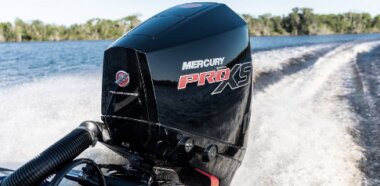
Mercury Force 40 Specifications
| Engine Model: Mercury Force 40 |
| Engine Type: 2-stroke 3-cylinder gasoline outboard engine |
| Total Displacement: 60 cu.in (0.98 L) |
| Rated Engine Power: 40 Hp (29.5 kW) at 5500 rpm |
| Fuel System: Dual side-draft carburetors |
____________________________________________________________________________________
The Mercury Force 40 is a 40Hp, 3-cylinder,
2-stroke outboard engine known for its rugged, no-frills design and
dependable operation. Its two-stroke powerhead delivers power with every
revolution, providing brisk acceleration and ample torque for planing
smaller boats. The engine utilizes a carbureted fuel system requiring a
50:1 pre-mix of fuel and oil, a simple and reliable approach that
eliminates the complexity of oil injection systems.
The Force 40 is equipped with Capacitor Discharge Ignition (CDI) for
consistent spark and easy starting. While lacking the refinement and
fuel economy of modern four-strokes, the Force 40 is valued in the used
market for its uncomplicated mechanics, parts availability, and the ease
with which owners can perform their own maintenance and repairs.
Maximum Power Output: 40 Hp at the propeller shaft.
Full Throttle Operating Range: 4500 to 5500 RPM.
Engine Type: Three-cylinder, two-stroke.
Displacement: 60 cubic inches (980 cc).
Bore and Stroke: 79.4 mm (3.125 inches) bore and 60.3 mm (2.375 inches)
stroke.
Fuel System: Single or dual carburetor(s).
Lubrication System: Fuel-oil premix at a 50:1 ratio.
Ignition System: Capacitor Discharge Ignition (CDI).
Starting System: Electric start standard on most models; manual start
available on some variants.
Alternator Output: Limited charging capability, sufficient for
maintaining battery charge on basic electrical systems.
Compatible Fuel: Unleaded regular gasoline with a minimum octane rating
of 87. Fuel must be pre-mixed with TC-W3 certified two-stroke outboard
oil at a 50:1 ratio.
The foundation of the Mercury Force 40 is a simple, durable two-cylinder
block designed for ease of manufacturing and service. Configuration:
Inline 3-cylinder. Cylinder Block Material: Precision-cast aluminum
alloy with cast-in iron cylinder liners for durability and wear
resistance.
Engine Type: Two-stroke, which utilizes a fuel and oil mixture for
internal lubrication, enabling a simpler design with fewer moving parts
than four-stroke counterparts.
The cylinder head design for this two-stroke engine has no valves and
instead uses ports in the cylinder wall for gas exchange, contributing
to its mechanical simplicity. Configuration: Single cylinder head
covering both cylinders.
Combustion Chamber: Optimized shape to promote efficient scavenging of
exhaust gases and intake of the fresh fuel-air charge. Valvetrain: None.
The engine utilizes piston-controlled intake and exhaust ports.
The fuel system on the Mercury Force 40 is a carbureted design, tuned to
deliver the correct air-fuel mixture for the two-stroke combustion
process. Induction System: Piston-port induction, where the descending
piston uncovers the intake port in the cylinder wall to draw in the
fuel-air mixture.
Fuel Delivery: Single or dual side-draft carburetors provide the
air-fuel mixture. A mechanical fuel pump, driven by crankcase pressure
pulses, delivers fuel from the boat's fuel tank. Fuel Mixing: The engine
requires fuel to be pre-mixed with two-stroke oil at a 50:1 ratio before
being poured into the fuel tank. This ensures all moving internal
components receive necessary lubrication.
The lubrication system on the Mercury Force 40 is entirely dependent on
the operator's preparation of the fuel mixture, a simple and direct
method. System Type: Total-loss lubrication, where oil mixed with the
fuel lubricates the crankshaft, bearings, and cylinder walls before
being burned and exiting with the exhaust.
Oil Type: TC-W3 certified two-stroke outboard oil. Mixing Ratio: 50:1
(fuel to oil). This ratio must be precisely measured and thoroughly
mixed to ensure adequate engine protection and prevent engine seizure.
To manage engine temperature, the Mercury Force 40 uses a positive
displacement water pump for raw water cooling. System Type:
Thermostat-controlled water cooling, drawing outside water through an
intake in the gearcase to cool the engine block and cylinder head.
Core Components: A rubber-impeller water pump, driven by the driveshaft,
pulls water from the lake or ocean. A thermostat regulates the flow to
maintain the engine at its optimal operating temperature for efficiency
and longevity.
| Mid Section and Lower Unit |
The mid-section houses the exhaust and driveshaft, while the lower unit
transfers power to the propeller. The gearcase is designed for
durability in recreational applications.
Gearcase Design: A rugged, precision-cut gearcase. Gear Ratio: Available
in two ratios depending on the specific model year and application:
2.00:1 or 2.33:1. The 2.33:1 ratio provides higher torque for heavier
boats. Gear Shift: Standard forward-neutral-reverse (F-N-R) shifting
operation.
Exhaust: Through-propeller exhaust release for quieter operation. At
idle, exhaust is released through a separate port above the
anti-ventilation plate. Gearcase Lubrication: The gearcase holds
dedicated high-grade marine gear lubricant. Regular inspection and
replacement are part of standard maintenance.
The engine is available with different systems for adjusting the
engine's angle relative to the transom. System Type: Depending on the
specific model and year, the Force 40 may be equipped with either a
manual tilt mechanism with multiple adjustment pins or an optional power
trim and tilt system.
Function (Manual Tilt): Allows the operator to manually lift and lock
the engine in one of several preset positions for shallow water
operation, trailering, or storage.
Function (Power Trim and Tilt): Hydraulic system controlled by dashboard
switches that allows on-the-fly trim adjustment for optimizing boat
attitude and fuel efficiency, as well as power tilting for trailering
and shallow water.
Propeller Shaft: 13-spline shaft, a common interface for propellers in
this power class.
Standard Propeller: The engine is typically fitted with an aluminum
three-blade propeller as standard equipment, selected to allow the
engine to operate within its recommended full-throttle RPM range.
Propeller Selection: The correct propeller allows the engine to operate
within its recommended full-throttle RPM range of 4500-5500 when the
boat is normally loaded. Various pitch and diameter options are
available to fine-tune performance for specific applications.
Shaft Length: The most common configuration is the long shaft, measuring
508 mm (20 inches), designed for boats with a standard transom height.
Short shaft versions (381 mm / 15 inches) were also produced for
smaller, lighter boats.
Dry Weight: The weight varies slightly by model year, shaft length, and
included features. The approximate dry weight range is 72.5 to 77 kg
(160 to 170 lbs).
Routine Maintenance (Every 100 Hours /
Annually):
Inspect and clean or replace spark plugs.
Check and clean the fuel filter.
Inspect the fuel system for leaks or deterioration, including fuel lines
and primer bulb.
Replace the gearcase lubricant.
Lubricate all moving parts and pivot points, including shift and
throttle linkages.
Check and clean the anti-corrosion anodes, replacing them if more than
50% eroded.
Inspect the water pump condition by checking tell-tale stream; replace
impeller as preventative maintenance every 2-3 years.
Critical Maintenance Items:
Fuel Mixing: Always use fresh fuel and mix TC-W3 oil at the precise 50:1
ratio to prevent engine damage.
Carburetor Cleaning: Periodically clean and rebuild the carburetor to
address issues caused by ethanol-blended fuels and ensure proper fuel
metering.
Lower Unit Seals: Inspect lower unit seals for leaks, as water intrusion
can cause significant gearcase damage.
Periodic Checks:
Battery condition and electrolyte levels on electric start models.
Propeller condition for dings, cracks, or fishing line.
Engine mounting hardware and steering system fasteners for correct
torque.
Compression testing to monitor internal engine health.
Cylinder Head Bolts: final torque of 18-22 Nm (13-16 lb-ft).
Spark Plugs: 27 Nm (20 lb-ft).
Propeller Nut: 40 Nm (30 lb-ft).
Gearcase Mounting Nuts: 40 Nm (30 lb-ft).
Engine Mounting Bolts (to transom): 40-45 Nm (30-33 lb-ft).
Aluminum Fishing Boats: Its lightweight and straightforward design make
it a popular choice for 14 to 16-foot aluminum john boats, semi-V hulls,
and tiller-steered fishing boats. Jon Boats and Utility Boats: The
engine's durability and easy maintenance suit it for small utility boats
used for hunting, fishing, or light commercial duties.
Small Pontoons: The engine provides adequate power for smaller, lighter
pontoon boats, offering economical cruising for inland waters. Basic
Runabouts: The Force 40 can power small fiberglass or aluminum
runabouts, providing entry-level planing performance for recreational
boating. Sailboat Auxiliary: Its reliability and relatively light weight
make it suitable as auxiliary power for smaller sailing vessels.
____________________________________________________________________________________
| Outboard Engines Technical Specifications |
| Small Engines Technical Specifications |
| Car Engines Technical Specifications |
| Industrial Engines Technical Specifications |