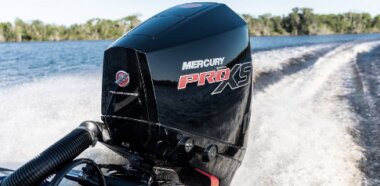
Mercury 300 L6 Verado Specifications
| Engine Model: Mercury Verado 300 L6 |
| Engine Type: 4-stroke inline 6-cylinder supercharger gasoline outboard engine |
| Total Displacement: 158 cu.in (2.6 L) |
| Rated Engine Power: 300 Hp (224 kW) at 6400 rpm |
| Fuel System: Sequential multi-point electronic fuel injection (EFI) |
____________________________________________________________________________________
The Mercury Verado 300 L6 is instantly
recognizable for its supercharged power delivery. Unlike
larger-displacement normally aspirated engines, the L6's 2.6-liter block
is force-fed by a precision screw-type supercharger, which provides
massive, immediate torque across the entire rpm range. This results in
explosive hole shots and the ability to maintain speed through heavy
seas without hesitation.
This power is delivered with an uncanny smoothness, thanks to the
inherent balance of the inline-six architecture and the Advanced
MidSection (AMS) that isolates vibration from the boat. Mated to
SmartCraft Digital Throttle and Shift (DTS) and electro-hydraulic power
steering, the Verado 300 offers a driving experience that is both
exhilarating and effortlessly controlled, making it a favorite for
experienced boat owners who refuse to compromise.
Engine Type: Inline 6-cylinder, four-stroke, equipped with a
supercharger.
Displacement: 2.6 Liters (158 Cubic Inches).
Power Output: 300 Hp at the propeller shaft (224 kW).
Full Throttle Operating Range: 5800-6400 RPM.
Air Induction: Supercharged system with a charge air cooler
(intercooler) and electronic boost pressure control to manage power
delivery and maintain air density.
Fuel Induction System: Sequential multi-port electronic fuel injection
(EFI) for precise fuel metering.
Ignition System: SmartCraft PCM 112 Digital Inductive ignition.
Alternator Output: A belt-driven 70-amp alternator produces 882 W,
sufficient for modern electronics and house loads.
Recommended Fuel: Unleaded gasoline with a minimum octane rating of 91
RON.
Engine Protection: The SmartCraft Engine Guardian system monitors vital
sensors and can automatically reduce engine power to prevent damage from
adverse operating conditions.
Starting System: Smart Start Electric, which protects the starter motor
and flywheel by preventing engagement if the engine is already running.
Emissions Star Rating: CARB 3-star rating.
The L6 engine's architecture is central to its performance character.
Cylinder Block: The engine is built on a robust 2.6-liter inline
6-cylinder block. This configuration is naturally balanced, eliminating
many of the primary vibrations found in other engine types. The
deep-skirt block design provides a stiff foundation for the rotating
assembly, ensuring durability under the high cylinder pressures
generated by the supercharger.
Cylinder Head and Valvetrain: While specific valve count is not listed
in the source data, the L6 Verado utilizes a sophisticated Dual Overhead
Cam (DOHC) design. This valvetrain, combined with the forced induction
system, optimizes airflow at high rpm to achieve the engine's 6400 RPM
redline and peak Hp figure.
The fuel system is engineered for both high performance and efficiency.
It uses a sequential multi-port electronic fuel injection (EFI) system,
where each cylinder receives a precisely timed and metered fuel charge
for optimal combustion under all loads. The engine's computer manages
this process, integrating with the electronic boost control to deliver a
seamless and responsive power curve.
The engine utilizes a high-capacity wet sump lubrication system to
handle the demands of forced induction. The recommended oil is Mercury
FourStroke 25W-40 Marine Oil, a formulation designed to withstand the
high temperatures and shear forces present in supercharged applications.
Routine checks are simplified by a convenient access door on the top
cowl.
Cooling is managed by a high-flow water-circulation system, critical for
maintaining safe operating temperatures in a supercharged engine. It
draws ambient water to cool the powerhead. The system also serves the
charge air cooler (intercooler), which reduces the temperature of the
compressed air from the supercharger before it enters the combustion
chamber, increasing air density and thus power output.
| Mid Section and Lower Unit |
The midsection and gearcase are designed to handle the engine's torque
and transmit it efficiently.
Advanced MidSection (AMS): A signature Verado feature, the AMS cradles
the powerhead by moving the engine mounts outward and aft. This design
isolates the powerhead from the transom, drastically reducing vibration
and noise transmitted to the hull and helm for an exceptionally smooth
ride.
Gearcase and Ratio: The engine is available with two primary gear ratio
options to suit different applications: a 1.75:1 ratio and a 1.85:1
ratio. This allows for optimization between low-end torque for heavy
loads and efficient cruising speeds. The standard gearcase size is the
heavy-duty 5.44-inch model.
Exhaust: Exhaust gases are expelled through the propeller hub,
contributing significantly to the engine's quiet underwater signature.
The Mercury 300 L6 Verado is fitted with a heavy-duty electro-hydraulic
power trim and tilt system. This allows for precise adjustment of the
engine angle to optimize boat performance, handling, and shallow water
operation. The system is fully integrated with the SmartCraft digital
controls.
Selecting the correct propeller is essential to fully utilize the Verado
300's supercharged torque band. Mercury offers a comprehensive range of
propellers specifically designed for the L6 gearcases. The correct
propeller must allow the engine to operate within its 5800-6400 RPM
full-throttle range. The specific pitch and diameter are determined by
factors such as boat weight, hull design, and intended use, and are best
selected using the Mercury Propeller Selector or dealer expertise.
Shaft Length Options:
20 inches (508 mm)
25 inches (635 mm)
30 inches (762 mm)
Dry Weight (Lightest Model): The lightest configuration of the Verado
300 L6 has a dry weight of 635 lbs (288 kg).
Every 100 hours:
Change engine oil and replace the oil filter.
Check the outboard for tightness to the boat transom.
Inspect thermostat visually for corrosion and/or for a broken spring.
Check engine water separating fuel filter for contaminants.
Clean and/or replace filter.
Drain and replace gearcase lubricant.
Check power steering fluid.
Inspect battery.
Check wiring and connectors.
Every 300 hours:
Replace water pump impeller.
Check power trim fluid.
Replace high‑pressure in‑line fuel filter.
Replace spark plugs.
Replace accessory drive belt.
Propeller Nut: 55 lb-ft (75 Nm).
Transom Mounting Bolts: 50-60 lb-ft (68-81 Nm).
Spark Plugs: 18-20 lb-ft (24-27 Nm).
Connecting Rod Bolts: 11 lb-ft (15 Nm), then 22 lb-ft (30 Nm), then an
additional turn of +90 deg.
Long Main Bearing Bolts: 20 lb-ft (27 Nm), then 55 lb-ft (41 Nm), then
an additional turn of +270 deg.
Cylinder Block Perimeter Bolts: 26 lb-ft (35 Nm).
Offshore Fishing Boats: Its immense low-end torque and ability to
maintain speed in rough seas make it a premier choice for serious
anglers who need to get to distant grounds quickly and reliably.
High-Performance Center Consoles: It delivers the thrilling acceleration
and top-end speed sought by performance-oriented boaters.
Multi-Engine Setups: The L6 is extremely popular in twin and triple
configurations on larger center consoles, cruisers, and catamarans.
These setups fully leverage the Verado's joystick piloting
compatibility, allowing for intuitive maneuvering and station-holding
capabilities usually reserved for much larger vessels. Heavy Fiberglass
Sports Boats: The supercharged torque is perfectly suited for powering
heavier, deep-V hulls out of the hole and onto plane with authority.
____________________________________________________________________________________
| Outboard Engines Technical Specifications |
| Small Engines Technical Specifications |
| Car Engines Technical Specifications |
| Industrial Engines Technical Specifications |