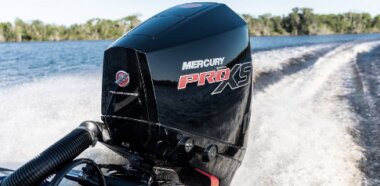
Mercury 200L Specifications
| Engine Model: Mercury 200L |
| Engine Type: 4-stroke 6-cylinder DOHC 24-valve gasoline outboard engine |
| Total Displacement: 209 cu.in (3.4 L) |
| Rated Engine Power: 200 Hp (149 kW) at 5800 rpm |
| Fuel System: Electronic Fuel Injection (EFI) |
____________________________________________________________________________________
The Mercury 200L is a 200-Hp, V-6 FourStroke
outboard engine designed for a wide range of boating applications, from
family cruising and fishing to commercial use. This engine is engineered
to deliver a superior balance of power, efficiency, and refinement. It
produces robust torque for strong acceleration and features a
sophisticated vibration-dampening design that results in an
exceptionally smooth and quiet ride.
The engine is equipped with advanced technologies, including Electronic
Fuel Injection (EFI) for optimal fuel economy and an 85-amp alternator
with idle charge to power modern onboard electronics. Available with
either standard remote mechanical controls or the advanced Digital
Throttle and Shift (DTS) system, the Mercury 200L provides precise
control and reliability, making it a versatile and compelling choice in
the 200hp class. Its compact design also simplifies repowering, fitting
many transoms with narrow engine wells.
Power: 200 hp (149 kW).
Full Throttle Operating Range: 5000-5800 RPM.
Displacement: 3.4 Liters, 209 Cubic Inches (CID).
Engine Type: V-6, 64-degree, Four-Stroke.
Valvetrain: 24-valve, Dual Overhead Camshaft (DOHC).
Bore and Stroke: 3.6 x 3.4 inches (92 x 86 mm).
Fuel System: Electronic Fuel Injection (EFI) with Advanced Range
Optimization (ARO).
Ignition System: SmartCraft ECM 70 Digital Inductive, providing precise
engine timing and control.
Alternator Output: 85 A (1,071 W) with an idle charge feature to
maintain battery health at low RPMs.
Gear Ratio: 1.85:1
Steering: Compatible with remote mechanical, hydraulic, and power
steering systems.
Digital Throttle and Shift (DTS) is available as an advanced control
option.
Engine Protection: SmartCraft Engine Guardian system protects the
powerhead from damage by monitoring for low oil pressure, over-rev
conditions, and overheat warnings, automatically reducing power if
necessary. Starting System: Electric start with SmartStart protection,
which prevents the starter motor from engaging if the engine is already
running.
Shaft Length: Available in a 20-inch (508 mm) long shaft model.
Recommended Fuel: Unleaded Regular gasoline with a minimum 87 Octane
rating (R+M/2) or 90 RON.
Recommended Oil: Mercury FourStroke Oil 10W-30, meeting NMMA FC-W.
Emissions: CARB 3-star rating, indicating a high level of emissions
control.
The foundation of the Mercury 200L is a robust and precisely engineered
powerhead. The cylinder block is a deep-skirt, 64-degree V-6 casting
designed for maximum strength and rigidity while minimizing weight. This
architecture provides a stable platform for the rotating assembly and
helps dampen vibrations. The closed-deck design contributes to the
engine's durability and consistent cylinder bore geometry under load.
The cylinder heads are advanced four-valve per cylinder designs,
featuring Dual Overhead Camshafts (DOHC). This configuration allows for
optimum placement of the valves, promoting superior airflow into and out
of the combustion chambers. The result is enhanced volumetric
efficiency, which translates to strong power output across the entire
RPM range.
Each cylinder is serviced by two intake and two exhaust valves, which
are actuated by the DOHC via precision-engineered followers. The use of
four valves per cylinder also contributes to the engine's smooth and
quiet operation compared to two-valve designs. The combustion chamber
shape is optimized to work in conjunction with the EFI system to ensure
efficient and complete fuel burn.
The fuel system on the Mercury 200L is a sophisticated,
computer-controlled Electronic Fuel Injection (EFI) setup. This system
precisely meters fuel to each cylinder based on real-time data from
multiple sensors, including intake air temperature, manifold pressure,
and engine coolant temperature.
The primary benefit of this system is exceptional fuel efficiency across
the entire operating range, from idle to wide-open throttle. A key
feature is the Advanced Range Optimization (ARO), which continuously
adjusts the fuel delivery strategy to maintain optimal combustion,
particularly during cruising speeds where engine efficiency is most
critical.
The EFI system also ensures reliable starting and crisp throttle
response in all weather conditions, eliminating the need for manual
choking. The air induction system utilizes a performance-tuned,
long-runner intake manifold, which is engineered to enhance low-end and
mid-range torque for improved acceleration and pulling power.
The engine utilizes a reliable wet sump lubrication system. Oil is drawn
from a sump at the base of the engine by a high-efficiency trochoid oil
pump and circulated under pressure to critical components such as the
crankshaft main bearings, connecting rod bearings, camshafts, and valve
train. This positive pressure system ensures a protective layer of oil
between moving parts, significantly reducing friction and wear.
The total oil capacity for the engine is 7.0 US quarts (6.6 liters).
Routine maintenance is simplified by features such as a top cowl service
door, which allows for easy access to the oil fill cap for checking and
adding oil without removing the engine cover. The use of NMMA FC-W
certified oil, such as Mercury FourStroke Oil 10W-30, is recommended to
ensure proper lubrication and corrosion protection in the marine
environment.
Cooling is managed by a positive displacement water pump, which is
mounted on the lower unit and driven by the driveshaft. This pump draws
water from outside the boat and circulates it through the engine's
cooling passages. The system is a thermostat-controlled, full-system
design. A thermostat, located in the cylinder head, regulates the flow
of coolant to maintain the engine at its most efficient operating
temperature, typically between 160°F and 180°F.
When the engine is cold, the thermostat remains closed, allowing the
engine to warm up quickly. Once operating temperature is reached, the
thermostat opens, allowing water to circulate through the block and
heads before being exhausted. This system ensures consistent operating
temperatures for optimal performance, fuel economy, and longevity, while
also providing a path for the water pump's tell-tale indicator to show
the system is functioning.
| Mid Section and Lower Unit |
The midsection of the Mercury 200L is designed for strength and
vibration isolation. It is a conventional midsection (CMS) that houses
the drive shaft and the exhaust passage. It incorporates sophisticated
vibration-dampening mounts that isolate the powerhead from the transom
and boat, contributing significantly to the quiet and comfortable ride.
The exhaust system is routed through the midsection and expelled through
the propeller hub (through-prop exhaust) for quieter operation, with a
separate idle relief port located above the cavitation plate for
improved low-speed running.
The lower unit is a critical component for transferring power to the
water. The Mercury 200L features a heavy-duty gearcase with a
hydrodynamic design to minimize drag and maximize speed. The standard
gearcase option is a 4.8-inch model. The forward, neutral, and reverse
(F-N-R) gear engagement is managed by a robust shift system.
The gear ratio for this model is 1.85:1, which provides an excellent
balance of acceleration and top-end speed. This gearcase is engineered
for durability and features a precision-cut set of spiral bevel gears
for quiet and efficient power transfer. The water pump is located at the
top of the lower unit, just below the anti-ventilation plate, allowing
for easy inspection and service.
The Mercury 200L is equipped with a standard Power Trim and Tilt (PTT)
system, which is hydraulically actuated. This system provides the
operator with complete control over the engine's angle relative to the
transom. The trim function is used while the boat is underway. By
adjusting the trim angle, the operator can optimize the boat's running
attitude for various conditions, improving fuel efficiency, ride
comfort, and speed. Trimming "in" helps the boat plane, while trimming
"out" can reduce drag and increase speed in calm water.
The tilt function is used to raise the engine completely out of the
water. This is essential for trailering, launching, beaching, and
performing maintenance or propeller changes. The system offers a
generous operating range. The maximum trim range is 20 deg (from -6° to
14°), which includes a shallow water drive capability, allowing
operation in very shallow water without the propeller striking the
bottom. The maximum tilt range is 73 deg (from -6° to 67°), providing
ample clearance out of the water.
The Mercury 200L is designed to be compatible with a wide range of
propellers, allowing boaters to fine-tune their boat's performance for
specific applications. Propeller selection is critical and depends on
factors such as boat weight, hull design, and intended use (e.g.,
watersports, cruising, or heavy load carrying). The correct propeller
will allow the engine to operate within its recommended full-throttle
RPM range of 5000-5800.
Mercury offers numerous propeller series, including the innovative Flo
Torq hub system, which incorporates a rubber hub to absorb shifting
shocks and protect the drivetrain. A qualified Mercury dealer can assist
in selecting the optimal propeller pitch and style to maximize
performance, whether the goal is maximum acceleration for skiing or
higher top speed for cruising. The engine is typically sold without a
propeller, as this is a dealer-fitted item based on the buyer's specific
needs.
Dry Weight: The lightest model has a dry weight of 475 lbs (216 kgs).
This figure can vary slightly depending on the specific configuration,
such as the inclusion of DTS vs. mechanical controls.
Shaft Length: The engine is available with a 20-inch (508 mm) shaft
length, which is designed for a standard 20-inch transom height.
Mounting Center-to-Center: The transom mounting bracket holes have a
standard spacing pattern to fit most boat transoms. The overall
dimensions are approximately 72 inches in height, 25 inches in width,
and 34 inches in depth, but these can vary slightly. Its slender width
is a key feature, allowing it to fit into engine wells designed for
narrower outboards, making it an excellent choice for repowering older
boats.
Key maintenance intervals and tasks
include:
Oil and Filter Change: Recommended after the first 20 hours of operation
(break-in period) and then every 100 hours of operation or annually,
whichever comes first. Gearcase Lubricant Change: Annually or every 100
hours.
Water Pump Inspection: The water pump impeller should be inspected
annually and replaced every three years or sooner if signs of wear or
damage are present, to prevent overheating. Fuel Filter: The engine is
equipped with a fuel filter/water separator that should be inspected and
replaced periodically to ensure clean fuel reaches the injectors.
Anodes: Sacrificial anodes are installed on the gearcase and transom
bracket to protect against galvanic corrosion. These must be inspected
regularly and replaced when they are 50% eroded. Valve Lash Inspection:
As a DOHC engine with mechanical lifters, valve lash should be checked
and adjusted according to the service manual schedule, although it is
not a frequent maintenance item.
Flushing: After each use in salt, brackish, or polluted water, the
cooling system must be flushed with fresh water to remove corrosive
deposits and debris. A garden hose attachment point is provided for easy
flushing.
The versatility of the Mercury 200L makes it suitable for a vast array
of boat types. Its power output and performance characteristics are a
perfect match for deep-V fishing boats, allowing them to reach offshore
fishing grounds quickly and efficiently. It is an ideal powerplant for
bay boats, flats boats, and multi-species fishing rigs, where its strong
low-end torque is beneficial for quick planing in shallow water.
The engine's smooth and quiet operation makes it a favorite for family
runabouts, deck boats, and pontoon boats, enhancing the comfort of
passengers. Its robust construction and reliable power also make it
suitable for lighter commercial applications, such as work skiffs and
patrol boats. For watersports enthusiasts, the engine provides the
necessary acceleration for towing skiers and wakeboarders.
____________________________________________________________________________________
| Outboard Engines Technical Specifications |
| Small Engines Technical Specifications |
| Car Engines Technical Specifications |
| Industrial Engines Technical Specifications |