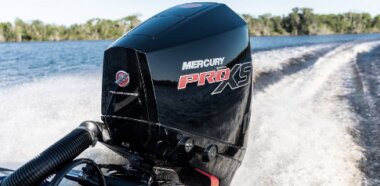
Mercury 200 Optimax Specifications
| Engine Model: Mercury Optimax 200 |
| Engine Type: 2-stroke 6-cylinder gasoline outboard engine |
| Total Displacement: 185 cu.in (3 L) |
| Rated Engine Power: 200 Hp (147 kW) at 5700 rpm |
| Fuel System: Direct fuel injection (DFI) |
____________________________________________________________________________________
The Mercury Optimax 200 is a 200-Hp, 60-degree
V6 direct fuel injection two-stroke outboard engineered for boaters
demanding high performance without compromise. Its defining
technological achievement is the two-stage Direct Fuel Injection (DFI)
system, which utilizes a belt-driven air compressor generating 5.4 bar
(80 psi) to atomize fuel directly into the combustion chambers.
This process results in fuel savings of up to 50 percent compared to
conventional carbureted two-strokes, along with dramatically reduced
exhaust emissions and smoke-free operation. The engine delivers
instantaneous throttle response and rapid acceleration characteristic of
two-stroke designs, making it ideal for applications requiring quick
hole-shot performance.
A sophisticated electronic multipoint oil injection system automatically
meters oil from a remote tank based on engine speed and load,
eliminating the need for pre-mixing fuel. The Mercury 200 Optimax is
fully integrated with the SmartCraft digital technology suite, providing
comprehensive engine data including fuel flow, engine temperature, water
pressure, and system diagnostics, along with the Engine Guardian
protection system that continuously monitors critical sensors and can
reduce power to prevent damage.
Maximum Power Output: 200 Hp (147 kW) at the propeller shaft.
Full Throttle Operating Range: 5000 to 5750 RPM.
Engine Type: 60-degree V6, two-stroke.
Displacement: 3.0 liters (3032 cc / 185 cubic inches).
Bore and Stroke: 92 mm (3.62 inches) bore and 76 mm (3.00 inches)
stroke.
Fuel System: Two-stage direct fuel injection (DFI) with Orbital
Combustion Process (OCP), utilizing a belt-driven air compressor
operating at 5.4 bar (80 psi).
Ignition System: PCM 07 digital inductive system with electronic spark
advance.
Alternator Output: 60 A (756 W) with water-cooled voltage regulator,
belt-driven.
Starting System: Electric start with Smart Start Protection, which
prevents starter engagement at high RPM.
Steering: Remote with hydraulic or power-assisted options.
Engine Management: Fully compatible with SmartCraft digital technology,
offering system monitoring, diagnostics, fuel flow data, water pressure
readings, and the Engine Guardian protection system. Emissions
Compliance: EPA Marine Tier 3 and CARB Three-Star rated for ultra-low
emissions.
Compatible Fuel: Unleaded regular gasoline with a minimum octane rating
of 87, containing up to 10 percent ethanol. Recommended Oil: Mercury or
Quicksilver Optimax/DFI 2-Cycle engine oil, specifically formulated for
direct injection systems.
The foundation of the Mercury Optimax 200 is a robust 60-degree V6
cylinder block engineered to withstand the higher combustion pressures
associated with direct fuel injection while maintaining the light weight
advantageous to two-stroke designs. Configuration: 60-degree V6.
Displacement: 3.0 liters (3032 cc / 185 cubic inches). Bore and Stroke:
The cylinder bore is 92 mm (3.62 inches) and the piston stroke is 76 mm
(3.00 inches).
Cylinder Block Material: Precision-cast aluminum alloy with cast-in iron
cylinder liners for durability and wear resistance. Engine Type:
Two-stroke, which generates power with every revolution of the
crankshaft, providing characteristic acceleration and power-to-weight
advantages.
The cylinder head design for this direct injection two-stroke engine
incorporates components to support the high-pressure fuel system and
optimized combustion chambers. Configuration: Two cylinder heads, one
for each bank of three cylinders. Combustion Chamber: Optimized shape to
promote efficient mixing of the directly injected fuel charge with
compressed air from the air compressor, ensuring complete combustion and
reduced emissions.
Valvetrain: The engine utilizes piston-controlled intake ports and
electronically controlled exhaust ports. The DFI system replaces
traditional carburetion with high-pressure fuel injectors mounted
directly in each cylinder head, delivering fuel at 5.4 bar (80 psi) air
pressure for superior atomization.
The fuel system is the defining technological achievement of the Mercury
200 Optimax, utilizing a two-stage direct injection process that
revolutionized two-stroke efficiency.
Induction System: Two-stage direct fuel injection (DFI) with the Orbital
Combustion Process (OCP). This system uses a belt-driven air compressor
to generate 5.4 bar (80 psi) of air pressure, which is used to atomize
fuel and inject it directly into the combustion chambers. The precise
metering and ultra-fine atomization enable near-complete combustion,
extracting maximum energy from each drop of fuel while drastically
reducing unburned hydrocarbons in the exhaust.
Fuel Delivery: An electric fuel pump draws fuel from the boat tank. A
separate high-pressure system, integrated with the air compressor,
raises fuel pressure for injection. The system includes a
water-separating fuel filter with a sensor that alerts the operator if
water reaches the full level in the filter chamber. The compressor air
intake filter must also be replaced periodically.
Fuel System Maintenance: The fuel line filter and water-separating fuel
filter should be replaced according to the maintenance schedule, and
water can be removed from the filter chamber as indicated by the warning
system. Recommended Fuel: Minimum 87-octane unleaded petrol is specified
to ensure proper combustion and prevent engine knocking.
The Optimax 200 incorporates a sophisticated electronic multipoint oil
injection system that automatically delivers the precise amount of oil
required for lubrication based on engine operating conditions. System
Type: Electronic multipoint oil injection with a dedicated oil pump. The
system meters oil from a remote oil tank directly to multiple points in
the engine.
Oil Tank Capacity: The engine utilizes a remote oil tank with a capacity
of 11.4 liters (12 US quarts). An engine reservoir capacity of 0.71
liter (0.44 US quart) is also specified. Oil Type: Mercury or
Quicksilver Optimax/DFI 2-Cycle engine oil is mandatory. This
specialized oil is formulated to resist dilution by fuel and to burn
cleanly within the direct injection combustion environment. Use of
inferior oil can result in carbon buildup on injectors, poor combustion,
and severe engine damage.
Warning System: The onboard warning system alerts the operator to low
oil level, critically low oil level, and oil pump failure through
distinct audible signals. Four beeps every two minutes indicate low oil,
while a continuous beep signals critically low oil or oil pump failure.
The system also provides warnings for water in fuel, cooling system
problems, sensor out of range conditions, and Engine Guardian
activation.
To manage engine temperature under varying loads and conditions, the
Mercury Optimax 200 uses a positive displacement water pump for raw
water cooling, integrated with thermostatic control and pressure
regulation. System Type: Water-cooled with thermostat and
pressure-controlled regulation, drawing outside water through an intake
in the gearcase to cool the engine block and cylinder heads.
Core Components: A rubber-impeller water pump, driven by the driveshaft,
pulls water from the lake or ocean. A thermostat regulates the flow to
maintain the engine at its optimal operating temperature for efficiency
and longevity. A pressure regulator maintains consistent water pressure
within the cooling passages. Water Pressure Specifications: At idle
speed (900-1000 RPM), water pressure should be 1.4-4.1 kPa (0.2-0.6
psi). At full throttle (5500 RPM with boat on plane), water pressure
should be 69-103 kPa (10-15 psi).
Warning System: The warning system emits a continuous beep if the
cooling system fails, indicating the Engine Guardian system has been
activated to protect the engine from overheating. The operator should
immediately check for a steady stream of water from the water pump
indicator hole. Flushing: The cooling system should be flushed with
fresh water after each use in salt, polluted, or muddy water to prevent
deposit buildup. Flushing can be performed with the engine stopped or
running at idle, using water pressure not exceeding 310 kPa (45 psi).
| Mid Section and Lower Unit |
The mid-section houses the exhaust and driveshaft, while the lower unit
transfers power to the propeller through a robust gearcase designed for
the engine's substantial torque output. Gearcase Design: A heavy-duty,
precision-cut gearcase engineered for durability and efficient power
transfer. The gear ratio varies depending on the specific gearcase
configuration.
Gear Ratio: Available in 1.75:1 or 1.85:1 ratios depending on the
gearcase model and application. Gear Shift: Standard
forward-neutral-reverse (F-N-R) shifting operation. Exhaust:
Through-propeller exhaust release for quieter operation and reduced back
pressure.
Gearcase Lubrication: The gearcase holds dedicated high-grade marine
gear lubricant. High Performance Gear Lubricant is specified. Regular
inspection and replacement are part of standard maintenance. Trim Tab:
An adjustable trim tab is provided to compensate for propeller steering
torque, reducing steering effort when the engine is trimmed for
operation.
The engine is equipped with an integrated electro-hydraulic system that
allows the operator to adjust the engine's angle relative to the transom
for optimal performance and convenience. System Type: Integrated power
trim and tilt, electro-hydraulic, controlled by dashboard-mounted rocker
switches or an auxiliary tilt switch on the engine.
Trim: Allows the operator to adjust engine angle within the first 20 deg
of travel while underway to optimize boat attitude, improve fuel
efficiency, and enhance ride quality. Trimming in (down) lowers the bow
for quicker planing and improved rough water ride. Trimming out (up)
raises the bow for increased top speed.
Tilt: Lifts the engine out of the water beyond the trim range for
trailering, launching, beaching, or shallow water anchoring.
Shallow Water Operation: When operating in shallow water, the engine can
be tilted up beyond the maximum trim range, provided engine speed is
kept below 2000 RPM and all water intake holes remain submerged. If
engine speed exceeds 2000 RPM while tilted up, the engine will
automatically return to the maximum trim range.
Manual Tilt Release: A manual tilt release valve is provided to allow
manual tilting of the engine in the event of power loss or system
malfunction. The valve must be tightened before operating the engine to
prevent unintended tilting during reverse operation.
Tilt Support Lever: A tilt support lever is provided for safely
supporting the engine in the tilted position during maintenance or
storage.
Propeller Selection: The correct propeller allows the engine to operate
within its recommended full-throttle RPM range of 5000-5750 when the
boat is normally loaded. Various pitch, diameter, and material options
are available from Mercury to fine-tune performance for specific
applications.
Propeller Material Options: Mercury offers propellers in both aluminum
and stainless steel. Stainless steel propellers offer improved
durability and performance, particularly for high-performance
applications. Propeller Inspection: Propeller blades should be inspected
before each use for damage.
Shaft Length is available in multiple
configurations:
Long shaft: 508 mm (20 inches), designed for boats with a standard
transom height.
Extra-long shaft: 635 mm (25 inches), for boats with higher transoms.
Width: 741 mm (29.2 inches).
Height: 1092 mm (43 inches).
Dry Weight: The approximate dry weight varies by model and shaft length.
The 20-inch shaft model weighs approximately 229 kg (505 lbs). Other
sources list weights ranging from 225 kg to 228 kg.
After Each Saltwater or Polluted Water Use:
Flush all internal cooling passages with fresh water.
Wash off all salt deposits and flush out the exhaust outlet of the
gearcase.
Every 100 Hours or Once Yearly, Whichever
Occurs First:
Lubricate all lubrication points. Lubricate more frequently when used in
salt water.
Replace spark plugs at first 100 hours or first year. After that,
inspect spark plugs every 100 hours or once yearly.
Replace spark plugs as needed. Spark plug type is NGK IZFR6J with a gap
of 0.8 mm (0.031 inches).
Replace water separating fuel filter.
Check corrosion control anodes. Replace if over 50 percent corroded.
Check more frequently when used in salt water.
Drain and replace gearcase lubricant.
Lubricate splines on the drive shaft and shift shaft.
Check power trim fluid.
Inspect battery. Battery minimum specification is 1000 marine cranking
A, 800 cold cranking A, and 180 amp hours.
Check control cable adjustments.
Check tightness of bolts, nuts, and other fasteners.
Replace water pump impeller (more often if overheating occurs or reduced
water pressure is noted).
Replace engine fuel line filter.
Replace compressor air intake filter.
Inspect alternator belt.
Lubricate the belt tensioner pivot shaft.
Critical Maintenance Items:
Oil Type: Use only Mercury or Quicksilver Optimax/DFI 2-Cycle engine
oil.
Water Pump Impeller: Replace the water pump impeller every 2-3 years or
approximately every 300 hours to prevent overheating due to impeller
failure.
Corrosion Protection: Regularly inspect sacrificial anodes and replace
when deteriorated.
Fuel System: Maintain the water-separating fuel filter and compressor
air intake filter according to schedule.
Battery Requirements: The engine requires a battery with minimum
specifications of 1000 marine cranking A (MCA), 800 cold cranking A
(CCA), and 180 amp hours (Ah) capacity.
Spark Plugs: Torque to specifications listed in the operator's manual or
service manual.
Propeller Nut: 40 Nm (30 lb-ft).
Gearcase Mounting Nuts: 40 Nm (30 lb-ft).
Water Intake Grate Screws: Apply Loctite 242 to threads and tighten to
specified torque.
Stator Fill/Drain Plug and Vent Plug Threads: Apply Loctite 567 PST Pipe
Sealant.
Nozzle Screws: Apply Loctite 271 Threadlocker.
Center Consoles: The engine is ideally suited for center console fishing
boats in the 20 to 24-foot range, providing the power and reliability
needed for offshore and coastal fishing. Bass Boats: Its excellent
power-to-weight ratio and rapid acceleration make it a popular choice
for high-performance bass boats, delivering the speed and hole-shot
required for tournament competition.
Bay Boats: The engine's durability and corrosion resistance suit it for
bay boats operating in coastal environments. Pontoon Boats: The Optimax
200 provides ample power for larger pontoon boats and tritoons, offering
the torque necessary for pulling water skiers and tubers. Fish and Ski
Boats: The engine delivers the quick acceleration required for water
sports while maintaining the fuel efficiency desired for recreational
cruising.
Offshore Sport Boats: The 200 Hp rating is suitable for powering smaller
offshore sport boats and cruisers, offering a balance of speed and
cruising capability. Commercial Applications: The robust construction
and proven durability of the Optimax platform make it suitable for light
commercial use in workboats, patrol craft, and rental fleets.
____________________________________________________________________________________
| Outboard Engines Technical Specifications |
| Small Engines Technical Specifications |
| Car Engines Technical Specifications |
| Industrial Engines Technical Specifications |