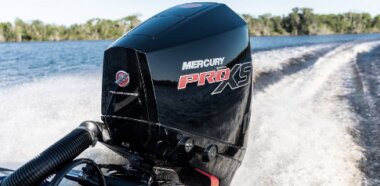
Mercury 175 Black Max Specifications
| Engine Model: Mercury Black Max 175 |
| Engine Type: 2-stroke 6-cylinder gasoline outboard engine |
| Total Displacement: 153 cu.in (2.5 L) |
| Rated Engine Power: 175 Hp (131 kW) at 5600 rpm |
| Fuel System: Fixed-jet carburetor |
____________________________________________________________________________________
The Mercury Black Max 175 is a legendary
outboard that signaled the start of a new era in high-performance
boating. Introduced in the mid-1970s, it was one of the first production
V-6 outboards, engineered to deliver exceptional power and smooth
operation. Its design was a clean-sheet approach, centered around a
compact 60-degree V configuration, which was chosen for its inherent
balance and reduced vibration compared to wider-angle designs.
While it is a product of its time and requires the attention typical of
a high-performance two-stroke, its robust construction, loop-charged
efficiency, and formidable power output have cemented its status as a
desirable and highly capable motor, often sought after for restoration
projects and classic performance boats.
The Mercury Black Max 175 is defined by engineering choices focused on
maximizing power from a compact and lightweight powerhead. It stands in
contrast to its contemporaries, offering a sophisticated design that
prioritized performance.
Engine Type: 60-degree V-6, 2-Stroke
Power: 175 HP (131 kW)
Displacement: 153 cubic inches (2.5 liters or 2.0 liters in the earliest
1976 model)
Full Throttle RPM Range: 5000-5600 RPM (some variants up to 5800 RPM)
Fuel Induction: Loop-charged with carburetion.
Lubrication System: Variable-ratio oil injection on later models, with
early models requiring pre-mixed fuel.
Recommended mix ratio is 50:1, though some operators may use richer
mixtures for break-in or severe service.
Alternator Output: 40 amp
Ignition System: Thunderbolt CD sealed ignition
Gear Ratio: 1.87:1 or 1.85:1, depending on the specific model year and
application.
Recommended Cylinder Compression: 115-125 psi.
At the heart of the Mercury 175 Black Max is its advanced powerhead. The
60-degree V arrangement was a key innovation, allowing the engine to be
more compact and streamlined than a traditional 90-degree V6. The block
and components were engineered for high-performance operation.
The loop-charged design was central to its efficiency, using precisely
positioned transfer ports to direct the fuel-air mixture in a loop
within the cylinder, promoting more complete combustion and greater
power output than the older cross-flow scavenging methods. The cylinder
heads are specific to the 175 HP variant, designed to optimize
compression and flame propagation. This robust construction, with
components like castings numbered 18488-C4, was built to withstand the
stresses of sustained high-speed operation.
The fuel system on the original Black Max 175 relies on carburetion. It
features preset, fixed-jet carburetors, which were designed to minimize
the need for user tinkering and maintain consistent fuel metering across
the power band. The engine utilizes a mechanical fuel pump to draw fuel
from the boat's tank. Early models required the operator to pre-mix
two-stroke oil with the gasoline, typically at a 50:1 ratio.
Later versions of the Black Max 175 incorporated Mercury's single-point,
variable-ratio oil injection system. This system, which drew oil from a
dedicated reservoir mounted under the cowl, automatically mixed the oil
with the fuel based on engine speed and load, eliminating the need for
pre-mixing.
The lubrication strategy evolved over the production life of the Black
Max 175. The foundational method for many years, especially the early
models, was total-loss lubrication where a pre-mixed fuel-and-oil blend
was used. The correct ratio is crucial for engine longevity, with 50:1
being the standard, though some sources mention using richer mixtures
like 40:1 or even 25:1 for break-in or heavy use, though this can lead
to fouling.
The advent of the oil-injection system marked a significant upgrade.
This system, with its reservoir under the cowl, provided convenience and
more precise lubrication, reducing smoke and plug fouling. Owners of
these later models must ensure the system is properly bled of air and
the pickup screens are clean to prevent oil starvation and the
activation of the audible warning horn.
The cooling system on the Mercury Black Max 175 is a conventional yet
vital water-cooled design. A belt-driven water pump, located in the
lower unit, draws water from outside the boat and circulates it through
water jackets surrounding the cylinders and within the cylinder head.
This continuous flow of water dissipates the intense heat generated
during combustion, maintaining optimal operating temperatures.
An audible overheat warning system was standard equipment, alerting the
operator to potential cooling issues such as a failing water pump
impeller or a blocked water intake. Routine replacement of the water
pump impeller is a critical maintenance task to ensure the engine's
survival.
| Mid Section and Lower Unit |
The mid-section houses the drive shaft housing and provides the
structural connection between the powerhead and the lower unit. It is
designed to streamline exhaust flow and house the components for the
trim and tilt system. The lower unit is a rugged assembly containing the
crucial gearcase.
It transfers the engine's power to the propeller and changes the
direction of rotation. A key feature for its time was the shear-proof
drive, which eliminated the traditional shear pin, a common failure
point. Instead, it used a robust hub system in the propeller to absorb
shock from impacts, enhancing dependability. The gear ratio is optimized
for the engine's power and torque characteristics.
Gear Ratio: 1.87:1 or 1.85:1.
Propeller Spline Count: 15
The Mercury 175 Black Max came standard with a powerful Power Trim
system, a significant feature that gave operators precise control over
the boat's attitude. This system, hydraulic in operation, allows the
operator to adjust the angle of the outboard relative to the transom
while underway. "Trimming" the engine out (tilting it away from the
transom) lifts the bow for increased speed and efficiency in calm water.
"Trimming" the engine in (tilting it toward the transom) pushes the bow
down for better hole-shot (acceleration) and a smoother ride in rough
water. The system also provides a high degree of tilt for trailering,
beaching, or working on the lower unit. A trim indicator on the control
box or dash allows the operator to see the engine's position at a
glance.
The recommended propeller for the Mercury Black Max 175 is the Black Max
series propeller, manufactured from Mercury's patented Mercalloy
material, a high-strength aluminum alloy. The choice of propeller pitch
is critical for achieving optimal performance and depends on the boat's
weight, hull design, and intended use. The correct propeller will allow
the engine to operate within its recommended WOT RPM range (5000-5600
RPM) when the boat is fully loaded.
The Mercury Black Max propeller is a 3-bladed design available in a wide
array of pitches, commonly ranging from as low as 5 inches up to 23
inches, to suit diverse applications. It utilizes the Flo-Torq II hub
system, which provides vibration dampening and acts as a shock absorber
to protect the lower unit gearcase from impact damage.
The Mercury Black Max 175 was designed to offer a compelling
power-to-weight ratio. Its compact 60-degree V architecture contributed
to a relatively lightweight package, enhancing the performance of the
boats it powered. Dimensions vary primarily by shaft length, with
20-inch and 25-inch models available to suit different transom heights.
Weight (Dry): Approximately 416 lbs. (189 kg) for early models, though
later variants like the 175 FourStroke are listed at 475 lbs.
Shaft Lengths: Available in 20" and 25" configurations.
Maintaining a Mercury Black Max 175 requires a systematic approach to
ensure its reliability and longevity. A compression test is the foremost
diagnostic step for any used engine, with all cylinders ideally showing
pressures within 10-15 psi of each other, around the 115-125 psi mark.
The fuel system requires regular attention, including cleaning or
rebuilding the carburetors and replacing fuel lines and filters to
prevent issues from ethanol-blended fuels.
The cooling system demands annual inspection and replacement of the
water pump impeller to prevent overheating. The lower unit gear oil
should be checked periodically for level and the presence of water, and
changed annually. For engines with oil injection, the system should be
bled according to procedures to ensure no air is trapped, and the pickup
screens must be kept clean. Proper maintenance extends the life of these
robust engines significantly.
Cylinder Head Bolts: 30-40 lb-ft.
Connecting Rod Nuts: 20-25 lb-ft.
Flywheel Nut: 100-110 lb-ft.
Lower Unit Mounting Nuts: 30-35 lb-ft.
The Mercury Black Max 175 is a versatile engine that found a home on a
wide variety of boat types. Its power and performance characteristics
made it a natural choice for the burgeoning bass boat market, where its
ability to propel lightweight hulls to high speeds was highly valued. It
was also a popular powerplant for bay boats, flats boats, and other
inshore fishing vessels.
Beyond fishing, the Black Max was fitted to performance runabouts,
family ski boats, and even larger center console boats and small
cruisers, where its power could push heavier loads. The "Black Max" name
itself became synonymous with Mercury's high-performance ethos,
representing a symbol of power and dependability on the water.
____________________________________________________________________________________
| Outboard Engines Technical Specifications |
| Small Engines Technical Specifications |
| Car Engines Technical Specifications |
| Industrial Engines Technical Specifications |