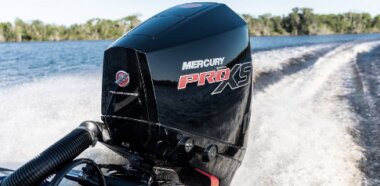
| Home / Outboard Engines / Evinrude Engines / Evinrude 9.8 4 stroke |
Evinrude 9.8 Hp 4 stroke Specs
| Engine Model: Evinrude 9.8 Hp 4-stroke |
| Engine Type: 4-stroke 2-cylinder gasoline outboard engine |
| Total Displacement: 12.8 cu.in (209 cc) |
| Rated Engine Power: 9.8 Hp (7.3 kW) at 6000 rpm |
| Fuel System: Carburetor |
____________________________________________________________________________________
| General Technical Data |
The Evinrude 9.8 is a four-stroke, two-cylinder
outboard engine. The engine displacement measures 12.8 cubic inches or
209 cc, achieved through a cylinder bore of 2.17 inches (55.0 mm) and a
piston stroke of 1.73 inches (44.0 mm). The powerhead produces a maximum
output of 9.8 Hp. The engine is designed to operate within a wide-open
throttle range of 5000 to 6000 rpm. Lubrication is provided by a wet
sump system with a total oil capacity of 27.2 fluid ounces or 804 ml.
The cooling system is water-cooled. The ignition system is a modern
design that meets EPA 2013 and CARB 3 Star emissions compliance
standards. Starting is accomplished either by an electric starter with a
12-volt, 145-watt, 6-amp alternator on models like the E10TPL4, or by a
manual recoil starter on models like the E10RG4. Fuel induction is
handled by a carburetor, and the engine is designed to run on 87 octane
fuel.
| Cylinder Block |
The cylinder block of the Evinrude 9.8 is machined to precise tolerances to ensure proper sealing and longevity. The cylinder bore is specified at 2.17 inches (55.0 mm). The stroke is 1.73 inches (44.0 mm). The powerhead is designed to be robust, and during service, compression testing is a critical diagnostic step.
A variation greater than 15 psi (100 kPa) between cylinders can indicate issues such as damaged pistons, broken piston rings, or scored cylinder walls. The block is configured for two cylinders and forms the foundation for the internal rotating assembly.
| Cylinder Head |
As a four-stroke engine, the Evinrude 9.8 utilizes a traditional valvetrain with intake and exhaust valves. The powerhead assembly includes the cylinder head, which requires specific torque procedures during installation.
The valve train operates within a sealed, lubricated environment provided by the engine oil. Precise valve clearance is essential for optimal performance, though specific gap measurements are not detailed in the source data. The powerhead incorporates modern engineering to ensure smooth operation within its 5000-6000 RPM operating range.
| Fuel System |
The Evinrude 9.8 employs a carbureted fuel induction system. This system is designed for simplicity and reliability. Fuel is drawn from an external remote fuel tank, as these models do not feature an integral tank. A primer bulb is used to fill the fuel system and carburetor before starting.
The fuel system includes a fast-idle choke system, which aids in easy and fast starting, particularly in cooler conditions. The recommended fuel is 87 octane unleaded gasoline. All fuel hoses and connections should be regularly inspected for leaks, and the primer bulb should be firm to the touch during operation.
| Lubrication System |
Engine lubrication is maintained through a wet sump system. The engine
is shipped from the factory without oil, so it is imperative to add the
correct amount before the first start to prevent powerhead damage. The
total oil capacity is 27.2 fluid ounces or 804 ml. The recommended oil
is Evinrude/Johnson 5W40 Ultra 4-Stroke oil.
If this specific oil is not available, a high-quality SAE 10W-30 or
10W-40 oil with the NMMA FC-W certification or an API rating of SF, SG,
SH, SJ, SL, or SM is acceptable. The oil level should be checked
regularly using the dipstick integrated into the oil filler cap.
| Cooling System |
The Evinrude 9.8 utilizes a water-cooled system to maintain optimal
operating temperatures. A water pump, driven by the driveshaft, draws
water from the lake or ocean and circulates it through passages in the
engine block and cylinder head.
A tell-tale or overboard indicator on the side of the engine provides a
visual confirmation that the water pump is functioning correctly; a
steady stream of water should flow from this indicator whenever the
engine is running. The system should be flushed with fresh water after
operation in salt or brackish water to prevent corrosion and deposit
buildup.
| Mid Section and Lower Unit |
The mid section connects the powerhead to the lower unit and houses the exhaust passage and driveshaft. The lower unit contains the gearcase, which holds the spiral bevel gear reduction system. The gear ratio is specified at 2.08:1.
The gearcase is filled with a dedicated lubricant, and its level should be checked with the engine vertical; lubricant should be even with the bottom of the level plug hole. A propeller shaft with a 12-spline drive is used to transfer power to the propeller. The gearcase capacity and specific lubricant type are not detailed in the source data but are critical for proper maintenance.
| Trim and Tilt System |
The trim and tilt system on the Evinrude 9.8 varies by model. The E10TPL4 model is equipped with a system that can be operated either manually or with power assistance. The E10RG4 model features a manual trim method.
On models with power trim and tilt, the hydraulic reservoir fluid level must be checked and maintained. The recommended fluid is Power Trim/Tilt Fluid or GM Dexron II. The fill cap should be torqued to 132 lb-in or 15 Nm after filling. The system should be cycled after filling to purge air.
| Propeller Information |
The Evinrude 9.8 is fitted with a three-bladed propeller. The propeller shaft has a 12-spline drive. Available propeller sizes for this engine include diameters of 8.50 inches with pitch options of 7, 8, and 9 inches. The correct propeller selection is critical; it must allow the engine to operate within its recommended full-throttle range of 5000-6000 RPM under normal load conditions.
If the pitch is too high, the engine will lug and may suffer damage; if too low, the engine may overspeed. During installation, the propeller shaft should be greased, and the propeller nut must be tightened to 9 lb-ft or 12 Nm, then further tightened if necessary to align the cotter pin hole.
| Dimensions and Weight |
The Evinrude 9.8 is available in two primary shaft lengths. The short shaft model (E10RG4) has a shaft length of 15 inches or 381 mm and weighs 81.5 lbs or 37 kg. The long shaft model (E10TPL4) has a shaft length of 20 inches or 508 mm and weighs 102.5 lbs or 46 kg.
| Maintenance Data |
Routine maintenance is essential for reliable operation. The engine runs
on 87 octane unleaded gasoline. It requires 27.2 fluid ounces (804 ml)
of 5W40 four-stroke outboard oil. The idle speed in gear should be set
to 900 ±50 RPM. A maintenance schedule guides service intervals.
The predelivery guide indicates that regular checks should include the
engine oil level, gearcase lubricant level, and trim/tilt fluid level.
Before each use, the fuel system should be checked for leaks. The
emergency stop function should be verified by pulling the safety lanyard
with the engine at idle, which must stop the engine immediately.
The water pump overboard indicator should be checked for a steady stream of water. Break-in procedures are critical for new engines and involve varying engine speeds during the first ten hours of operation to allow proper seating of components.
| Tightening Torques |
Critical torque specifications include the cylinder head bolts, which
must be torqued in a 2-3 stage sequence to 25-30 lb-ft or 33.9-40.7 Nm.
The propeller nut is torqued to 70-80 lb-ft (95-109 Nm). The trim/tilt
system filler cap requires 15 Nm or 132 lb-in.
For routine maintenance, spark plugs are installed at 10-14 lb-ft (14-19
Nm). The gear oil drain plug should be tightened to 10-12 lb-ft (14-16
Nm). The engine oil drain bolt requires 15-18 lb-ft (20-25 Nm). During
propeller installation, the initial propeller nut torque is 9 lb-ft (12
Nm) before final tightening for cotter pin alignment.
| Boat Applications |
The Evinrude 9.8 is ideally suited for a range of small to medium
watercraft where a balance of power, weight, and fuel efficiency is
desired. The short shaft model is perfect for small fishing boats,
dinghies, and inflatable boats where portability is important.
The long shaft model is well-suited for sailboats as auxiliary power or
for larger inflatables and small aluminum fishing boats. The
availability of both manual rope start and electric start models allows
operators to choose based on their preference for simplicity or
convenience. The engine's 9.8 Hp output provides ample thrust for
planing small hulls and efficient cruising.
____________________________________________________________________________________
| Outboard Engines Technical Specifications |
| Small Engines Technical Specifications |
| Car Engines Technical Specifications |
| Industrial Engines Technical Specifications |